
When a child finishes a puzzle or pours water without spilling, most of us say "Good job!" without thinking. It comes from love. In a Montessori classroom, though, you will hear guides say it very rarely. Instead, they describe what the child did, notice the effort, or ask the child how they feel about it.
The reason is simple. Montessori wants the satisfaction to come from the work itself, not from an adult's approval. A child who hears "Good job!" all day can start working to be praised, and start looking up at the adult after every step. A child whose effort is noticed learns to judge their own work, to keep going when it is hard, and to feel the quiet pride of having done something real.
Dr. Montessori once found a teacher giving a silver cross to one child as a reward. When it slipped off his neck, he looked at it "with an air of indifference" and went back to his work. The work itself was what he cared about.
This does not mean we stop being warm. It means we trade quick, general praise for words that are specific and honest. Below are words to use, grouped by the moment, with Spanish versions for our bilingual families.
- Noticing effort
- Describing what you see
- Inviting your child to reflect
- Kindness and helping others
- When something is hard
- Baby sign language
- Phrases to use less
Noticing effort
Use these when your child has worked hard, kept going, or tried something new. Talk about the effort, not the result.
In English
- "You kept trying until it worked."
- "You worked on that for a long time."
- "You were so focused. You didn’t stop until it was done."
- "I saw you try a different way."
- "You did it by yourself."
En español
- "Seguiste intentando hasta que funcionó."
- "Trabajaste en eso mucho tiempo."
- "Estabas muy concentrado."
- "Lo hiciste tú solo." / "Lo hiciste tú sola."
Describing what you see
Simply say what your child did, like a kind narrator. There is no judgment in it, so your child decides how they feel about their work.
In English
- "You put every block back on the shelf."
- "You poured slowly, and the water stayed in the cup."
- "You buttoned all four buttons."
- "You used blue and yellow, and they made green."
- "You washed your plate and put it away."
En español
- "Pusiste cada bloque en su lugar en el estante."
- "Serviste el agua despacito y no se derramó."
- "Te abrochaste los cuatro botones."
- "Lavaste tu plato y lo guardaste."
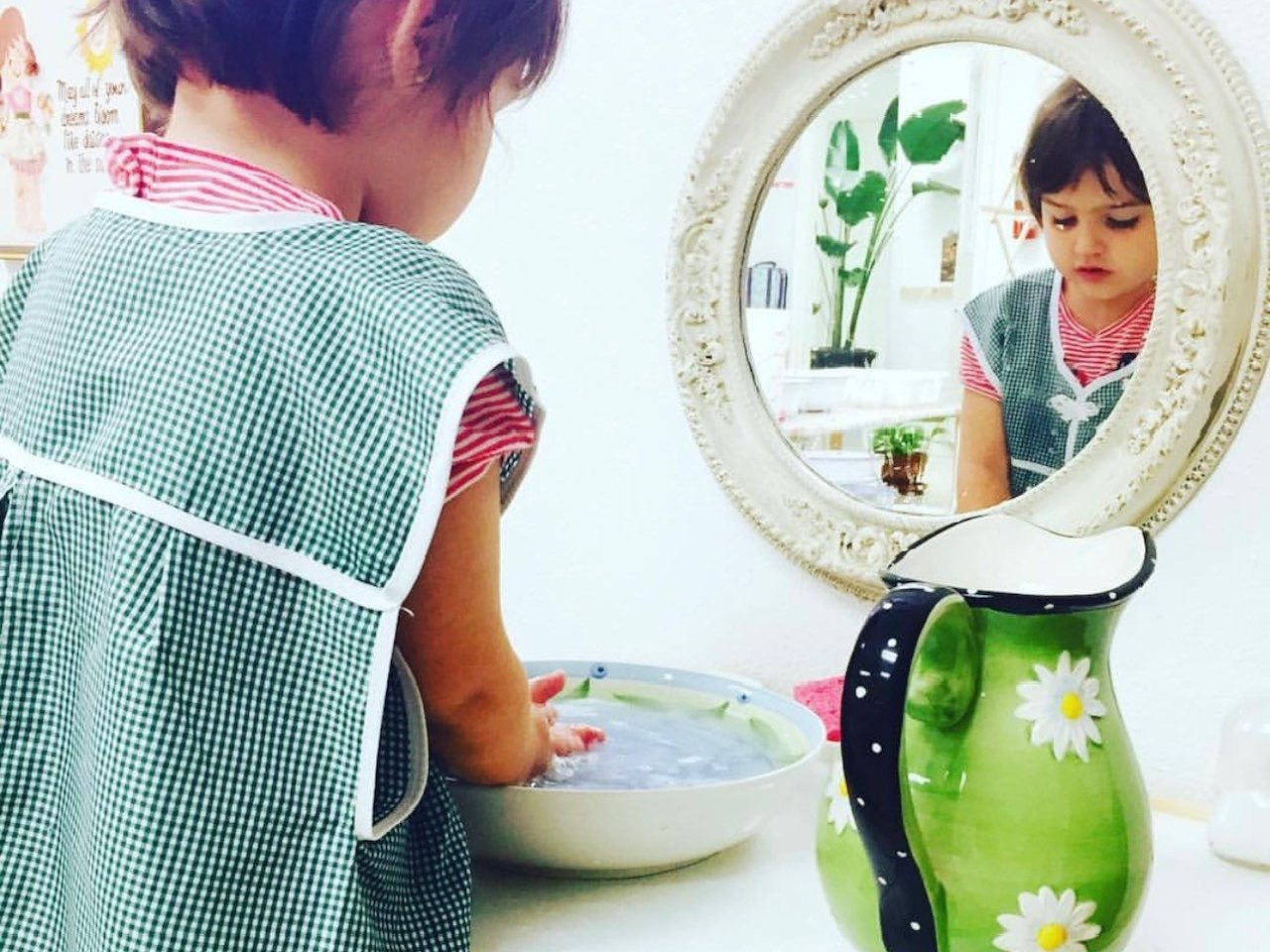
Practical life at Casa: washing, pouring, and caring for the classroom.
Inviting your child to reflect
Ask, then wait. A question turns your child back toward their own work and their own feelings.
In English
- "How do you feel about it?"
- "Tell me about your drawing."
- "What was the hardest part?"
- "What would you like to do next?"
- "You look proud of your work."
En español
- "¿Cómo te sientes con tu trabajo?"
- "Cuéntame de tu dibujo."
- "¿Qué fue lo más difícil?"
- "¿Qué te gustaría hacer ahora?"
Kindness and helping others
In a Montessori classroom this is part of grace and courtesy. Name the kind act and how it helped someone else.
In English
- "You waited for your turn, and your friend could finish."
- "You helped carry the tray. That made the job easier for everyone."
- "You noticed he was sad and brought him a tissue."
- "Thank you for holding the door for us."
- "How do you think your friend felt?"
En español
- "Esperaste tu turno y tu amigo pudo terminar."
- "Gracias por ayudar a cargar la charola."
- "Te diste cuenta de que estaba triste y lo ayudaste."
- "¿Cómo crees que se sintió tu amiga?"
When something is hard
Stay calm, name the feeling, and leave room for your child to try again. Mistakes are part of the work.
In English
- "This is hard. You are still trying."
- "Mistakes help us learn. What could you try next?"
- "Would you like to try again, or should I show you slowly?"
- "Take a breath. I’ll wait."
- "Yesterday this was hard. Today you got closer."
En español
- "Esto es difícil, y sigues intentando."
- "Los errores nos ayudan a aprender. ¿Qué puedes intentar ahora?"
- "Respira. Yo te espero."
- "¿Quieres intentarlo otra vez o te enseño despacito?"
With babies in the Infant Nido Room
The same idea starts on the first day. Babies don't need "Good job!" either. They respond to a calm voice that names what they are doing: "You reached the ball." "You rolled all the way over." "You're looking at the light." Your words give your baby language, and your attention tells them their effort matters.
Baby sign language: words with your hands
Before babies can talk, they can use their hands. In the Infant Nido Room and at home, a few simple signs give your baby a way to tell you what they need, which means less frustration for everyone. Always say the word out loud as you sign it, in English, Spanish, or both. The sign helps your baby connect to the spoken word.
Start with two or three signs and use them every day, in the same way each time. Many babies begin signing back somewhere between 6 and 12 months. When your baby signs to you, respond right away and name it: "You signed more. Here is more." That is encouragement too.
Bring the fingertips of each hand together, then tap the fingertips of both hands together a couple of times.
At meals: offer a small piece, then sign and say "more?"
Watch the sign ›Hold both hands out in front of you, palms up and fingers spread, then twist your wrists so your hands turn down and away.
At the end of a meal or an activity.
Watch the sign ›Pinch the tips of your fingers together and tap them on your lips a few times.
Before snacks and meals.
Watch the sign ›Make a fist and open and close it a few times, like squeezing.
For a bottle, nursing, or a cup of milk.
Watch the sign ›Hold up three fingers (pointer, middle and ring) to make a W, and tap it on your chin a couple of times.
When your child is thirsty, or while pouring water together.
Watch the sign ›Hold one hand flat, palm up. Put a thumbs-up on it with the other hand and lift both together.
When something is hard, so your child can ask instead of getting frustrated.
Watch the sign ›Place a flat hand on your chest and move it in a small circle.
Whenever your child asks for something.
Watch the sign ›Touch the fingertips of a flat hand to your chin, then bring the hand forward and down, palm up.
When someone helps or hands your child something.
Watch the sign ›These are American Sign Language (ASL) signs. Tap "Watch the sign" to see each one in a short video.
Phrases to use less, and what to say instead
These phrases are not harmful, and no parent needs to feel bad for saying them. Try swapping in one new phrase this week and see what changes.
| Instead of | Try |
|---|---|
| "Good job!" | Say what you saw: "You put on both shoes." |
| "Good boy" / "Good girl" | Name the action, not the child: "You were gentle with the baby." |
| "I’m so proud of you." | "You worked hard. How does it feel?" or "You must feel proud of yourself." |
| "You’re so smart." | "You kept thinking until you solved it." |
| "That’s beautiful!" | "Tell me about it." or "You used so many colors." |
| "If you clean up, you get a treat." | "When the toys are back on the shelf, we’ll go outside." |
| "Here, let me do it." | "Take your time. I’ll wait." Step in only if your child asks or is unsafe. |
| "Don’t cry, you’re fine." | "You’re upset. I’m here with you." |
Three small habits that help
- Pause before you speak. Often the best response is a smile and no words at all. Let your child enjoy the moment first.
- Don't interrupt concentration. If your child is deep in their work, wait until they finish. Their focus is worth protecting.
- Say it the same way at home and at school. When children hear the same kind of words in both places, it feels natural to them. Our St. Martin's Day post has more ideas for naming kindness at home.
From The Casa Shop
Casa clothing, rain gear and nap mats, ready for the next school day.
See it in our classrooms
Want to hear how our guides talk with children? Come see a Montessori morning at Casa.
Book a Tuesday tourSources
- Maria Montessori, The Montessori Method (1912), Chapter V, “Discipline” (Project Gutenberg)
https://www.gutenberg.org/ebooks/39863 - The Montessori Foundation, “Words of Praise,” Tomorrow’s Child, September 2023
https://www.montessori.org/words-of-praise/ - Simone Davies, “Beyond Bribes, Rewards, and Punishments: A Montessori Approach to Building Intrinsic Motivation,” Tomorrow’s Child, May 2022 (The Montessori Foundation)
https://www.montessori.org/beyond-bribes-rewards-and-punishments/ - Bimpe Pogoson, AMI 3–6 Trainer, “Self-Discipline and Self Confidence in Montessori,” Association Montessori Internationale (AMI)
https://montessori-ami.org/node/7613 - Signing Time, ASL sign dictionary (More, All done, Eat, Milk, Water, Help, Please, Thank you)
https://signingtime.com/blogs/dictionary - Pathways.org, “Parents’ Guide to Baby Sign Language”
https://pathways.org/watch/parents-guide-baby-sign-language
With warmth,
Admin
Casa de Niños Bilingual Montessori School
For more tips, follow @casadeninosbilingualmontessori
← Back to the Casa Blog