
This month in the garden
November noviembre 2026
- Sunday, November 1
With your child. Rake a leaf pile together. Sort the leaves by color or size, then add them to the compost.
- Monday, November 2
Plant this week: Asian greens, like bok choy. It is planting time for this in Williamson County.
- Tuesday, November 3
Spanish garden word: la hoja. “la hoja” means the leaf. Use it while you work together.
- Wednesday, November 4
For babies in the Infant Nido Room. Sit by a window or in a shaded spot and watch the leaves fall. With you right there, let your baby touch a big dry leaf and hear it crunch.
- Thursday, November 5
Spanish garden word: la escoba. “la escoba” means the broom. Use it while you work together.
- Friday, November 6
Friday garden check. Water check: push a finger into the soil together. If it feels dry, it is time to water.
- Saturday, November 7
Garden job for the family. Save fallen leaves. Shred them for mulch or add them to the compost.
- Sunday, November 8
With your child. Sow a short row of radishes; the adult hands out the seeds.
- Monday, November 9
Plant this week: Beets. It is planting time for this in Williamson County.
New moon. Old almanac tradition: sow leafy greens and root crops around the new moon.
- Tuesday, November 10
Spanish garden word: la canasta. “la canasta” means the basket. Use it while you work together.
- Wednesday, November 11
For toddlers. Sweep a few leaves off the path with a small broom.
- Thursday, November 12
Spanish garden word: el rábano. “el rábano” means the radish. Use it while you work together.
- Friday, November 13
Friday garden check. Look for something new in the garden, like a sprout, a flower or a bug, and name it together.
- Saturday, November 14
Garden job for the family. Cover empty vegetable beds with leaves and compost, and add fresh mulch around plants.
- Sunday, November 15
Last day to plant: Beets, Swiss chard, collards, fava beans, mustard greens and turnips. After this, wait for the next season.
With your child. Spread a blanket of dry leaves over an empty bed.
- Monday, November 16
Plant this week: Cool-season greens. It is planting time for this in Williamson County.
- Tuesday, November 17
Spanish garden word: barrer. “barrer” means to sweep. Use it while you work together.
- Wednesday, November 18
For toddlers. Carry leaves to the compost in a small basket or wagon.
- Thursday, November 19
Spanish garden word: sembrar. “sembrar” means to sow. Use it while you work together.
- Friday, November 20
Friday garden check. Wipe the garden tools with a cloth and help your child put each one back in its place.
- Saturday, November 21
Garden job for the family. Family garden time: water, pull a few weeds and check on what you planted.
- Sunday, November 22
With your child. Pull small weeds after a rain, when the soil is soft.
- Monday, November 23
Plant this week: Kale. It is planting time for this in Williamson County.
- Tuesday, November 24
Full moon, the Beaver Moon. Take an evening walk to see the moon and check on the garden.
Spanish garden word: cubrir. “cubrir” means to cover. Use it while you work together.
- Wednesday, November 25
For toddlers. Water new seedlings with a small watering can.
- Thursday, November 26
Spanish garden word: recoger. “recoger” means to gather. Use it while you work together.
- Friday, November 27
Average first freeze, Williamson County. Check the forecast. Below 28°F, cover tender plants the evening before.
Friday garden check. Visit one plant each Friday and talk about how it has changed since last week.
- Saturday, November 28
Garden job for the family. Family garden time: water, pull a few weeds and check on what you planted.
- Sunday, November 29
With your child. Compost: fill a basket with clean, dry leaves and save it next to the compost for the adult to add a little at a time.
- Monday, November 30
Last day to plant: Garlic, kale and shallots. After this, wait for the next season.
Plant this week: Lettuce. It is planting time for this in Williamson County.
Nov. 27 · Average first freeze
Mar. 4 · Average last freeze
When the low drops below 28°F, cover tender plants with frost cloth. These dates are averages for Williamson County, not predictions, so watch the forecast. Planting times come from the Williamson County Vegetable Planting Guide from Texas A&M AgriLife Extension and the Texas Master Gardeners (see sources).
Month-by-month guide
November noviembre 2026
What to plant
- Asian greens, like bok choy · bok choy
- Beets · betabel (first half)
- Swiss chard · acelga (first half)
- Collards · berza (first half)
- Fava beans · habas (first half)
- Garlic · ajo
- Cool-season greens · verduras de hoja
- Kale · col rizada
- Lettuce · lechuga
- Mustard greens · mostaza (first half)
- Radishes · rábanos
- Shallots · chalotes
- Spinach · espinaca
- Turnips · nabos (first half)
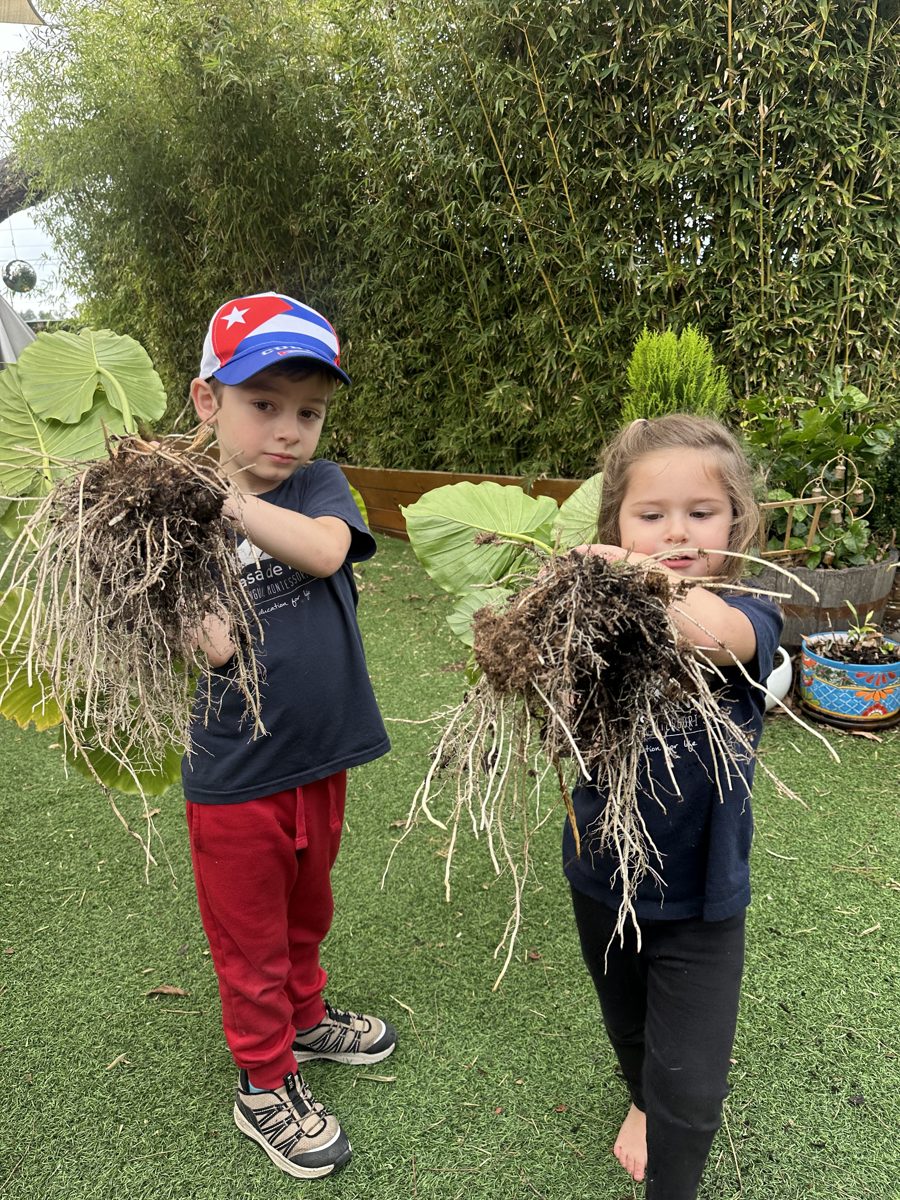
Garden jobs for the family
- Save fallen leaves. Shred them for mulch or add them to the compost.
- Cover empty vegetable beds with leaves and compost, and add fresh mulch around plants.
- The average first freeze is around November 27. Have frost cloth ready.
- Last call this month to plant garlic, shallots and kale.
Try together this month: Rake a leaf pile together. Sort the leaves by color or size, then add them to the compost.
November activities for babies, toddlers and preschoolers
Infant Nido Room
Sit by a window or in a shaded spot and watch the leaves fall. With you right there, let your baby touch a big dry leaf and hear it crunch.
Toddlers
- Sweep a few leaves off the path with a small broom.
- Carry leaves to the compost in a small basket or wagon.
- Water new seedlings with a small watering can.
Ages 3 to 6
- Sow a short row of radishes; the adult hands out the seeds.
- Spread a blanket of dry leaves over an empty bed.
- Pull small weeds after a rain, when the soil is soft.
Nature study and compost
Compost: fill a basket with clean, dry leaves and save it next to the compost for the adult to add a little at a time.
Spanish words to use: la hoja, la escoba, la canasta, el rábano · barrer, sembrar, cubrir, recoger
December diciembre 2026
What to plant
- Asian greens, like bok choy · bok choy
- Cool-season greens · verduras de hoja
- Lettuce · lechuga
- Radishes · rábanos
- Spinach · espinaca
Garden jobs for the family
- Feed winter vegetables every two weeks with a gentle fertilizer like fish emulsion.
- When the low drops below 28°F, cover plants with frost cloth and secure the edges.
- Turn the compost on mild days. Pull small weeds; clean and oil tools.
- Start broccoli, cabbage, cauliflower, kale and collard seeds in trays to plant out in January. Order seed potatoes.
Try together this month: Look through a seed catalog together and let your child choose one vegetable to grow in spring.
December activities for babies, toddlers and preschoolers
Infant Nido Room
Hold up a big, clean kale leaf and slowly turn it front to back while your baby looks. Name it: col rizada.
Toddlers
- Wipe the outside of an empty planter with a damp cloth.
- Carry the light frost cloth to the adult who is covering the greens.
- Wipe garden tools and hang each one in its place.
Ages 3 to 6
- Set a kale or lettuce plant into a prepared pot and press the soil around it.
- Help unfold the frost cloth and set rocks along the edges.
- Push a finger into the soil to check if it is dry before watering.
Nature study and compost
Nature study: on a frosty morning, look at the grass from the window. Look again at lunch and talk about what changed.
Spanish words to use: la col rizada, la maceta, el paño, la helada · limpiar, trasplantar, cubrir, observar
January enero 2027
What to plant
- Artichoke crowns · alcachofa
- Asian greens, like bok choy · bok choy
- Asparagus crowns · espárragos
- Beets · betabel (second half)
- Broccoli transplants · brócoli (second half)
- Cabbage transplants · repollo (second half)
- Carrots · zanahorias (second half)
- Cauliflower transplants · coliflor (second half)
- Swiss chard · acelga (second half)
- Collards · berza (second half)
- Fava beans · habas
- Cool-season greens · verduras de hoja
- Kale · col rizada (second half)
- Kohlrabi · colinabo (second half)
- Leeks · poros (second half)
- Lettuce · lechuga
- Mustard greens · mostaza (second half)
- Onion transplants · cebolla
- English, snap and snow peas · chícharos (second half)
- Radishes · rábanos
- Spinach · espinaca
- Turnips · nabos (second half)
Garden jobs for the family
- Set out onion transplants in January and early February.
- From mid-January, plant broccoli, cabbage and cauliflower transplants and the seedlings started in December.
- Keep frost cloth handy. January and February can still bring hard freezes.
Try together this month: Plant onion sets in a pot. Small fingers can press each one in, pointy end up.
January activities for babies, toddlers and preschoolers
Infant Nido Room
Let your baby watch from a blanket nearby while you wipe a small watering can. Name each thing: regadera, agua, tierra.
Toddlers
- Scrub an empty, unbreakable pot with a soft brush.
- Carry seedling trays to the garden with two hands.
- Pour a little water at the base of a lettuce plant.
Ages 3 to 6
- Set onion plants into holes the adult has made, and press the soil around them.
- Water new broccoli and cabbage plants at the base, from mid-January.
- After a cold night, lift the frost cloth together and see what changed.
Nature study and compost
Nature study: pick one tree to visit every week this winter. Stand in the same spot and look for anything new.
Spanish words to use: el cepillo, la regadera, la cebolla, la etiqueta · cepillar, regar, presionar, etiquetar
February febrero 2027
What to plant
- Artichoke crowns · alcachofa
- Asian greens, like bok choy · bok choy
- Asparagus crowns · espárragos (first half)
- Beets · betabel
- Broccoli transplants · brócoli
- Cabbage transplants · repollo
- Carrots · zanahorias
- Cauliflower transplants · coliflor
- Swiss chard · acelga
- Collards · berza
- Cool-season greens · verduras de hoja
- Kale · col rizada
- Kohlrabi · colinabo
- Leeks · poros
- Lettuce · lechuga
- Mustard greens · mostaza
- Onion transplants · cebolla (first half)
- English, snap and snow peas · chícharos (first half)
- Potatoes · papas
- Radishes · rábanos
- Spinach · espinaca
- Turnips · nabos
Garden jobs for the family
- Plant potatoes from late January through February.
- February is the last month for broccoli, cabbage and cauliflower transplants.
- Work compost into beds so they are ready for spring planting.
Try together this month: Look at a seed potato together and count its "eyes." Each eye can grow a new plant.
February activities for babies, toddlers and preschoolers
Infant Nido Room
Show your baby a whole onion. Turn it slowly and name it: la cebolla.
Toddlers
- Set empty pots on a tray for the adult.
- Give a newly planted bed a small pour of water.
- Carry the harvest basket for the last lettuce leaves.
Ages 3 to 6
- Drop seed potatoes into the row and cover them with soil.
- Count the “eyes” on a seed potato before planting.
- Spread compost on the beds with a small shovel.
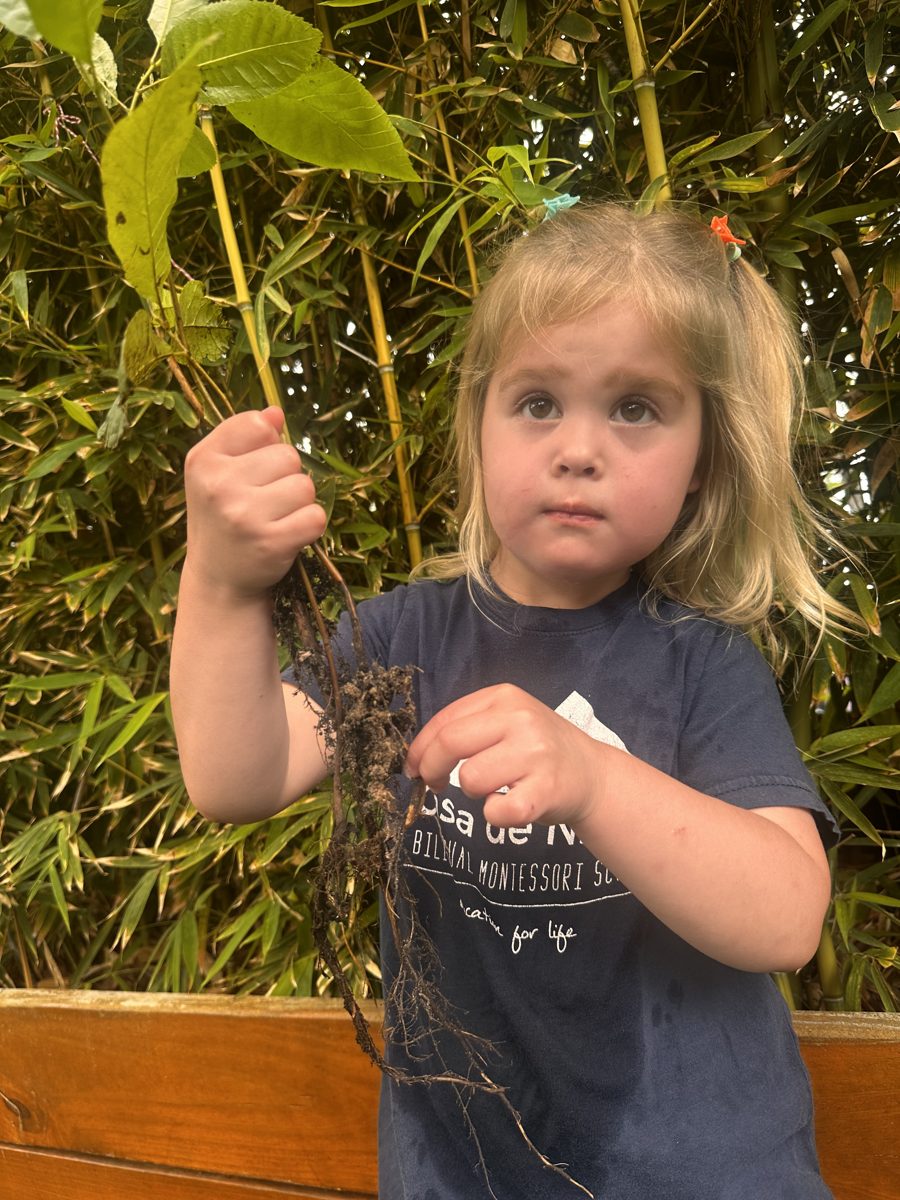
Nature study and compost
Nature study: draw the same seedling once a week, and notice each new leaf.
Spanish words to use: la papa, la bandeja, la plántula, el lápiz · colocar, cubrir, contar, dibujar
March marzo 2027
What to plant
- Snap and lima beans · ejotes y frijoles
- Beets · betabel
- Cantaloupe · melón (second half)
- Carrots · zanahorias (first half)
- Swiss chard · acelga
- Corn · maíz
- Cucumbers · pepinos
- Eggplant transplants · berenjena (second half)
- Cool-season greens · verduras de hoja (first half)
- Warm-season greens · verduras de verano (second half)
- Kohlrabi · colinabo (first half)
- Lettuce · lechuga (first half)
- Mustard greens · mostaza
- Southern peas · frijol de ojo negro (second half)
- Pepper transplants · chiles (second half)
- Pumpkins · calabaza de Halloween (second half)
- Radishes · rábanos
- Summer squash · calabacita
- Winter squash · calabaza (second half)
- Tomato transplants · jitomate
- Turnips · nabos
Garden jobs for the family
- The average last freeze is around March 4. Watch the forecast for a late cold snap.
- Warm-season planting begins: tomatoes, beans, squash, cucumbers and corn.
- Finish harvesting winter greens before the heat makes them bitter and go to seed.
Try together this month: Plant big seeds like beans or squash. They are easy for small hands to hold and place.
March activities for babies, toddlers and preschoolers
Infant Nido Room
From the porch, watch an adult water a new plant, and listen together to the water on the soil.
Toddlers
- Water the base of one new plant with a small can.
- Put lettuce leaves the adult picked into the harvest basket.
- When you find a worm, watch it for a minute, then put it back gently.
Ages 3 to 6
- After the last freeze, help plant a tomato in a prepared hole and water it in.
- Cover bean and squash seeds the adult has set in a row.
- Draw plant labels and push them into the soil.
Nature study and compost
Nature study: watch a flower from a little distance. If a bee visits, draw where it landed.
Spanish words to use: el tomate, el frijol, la flor, la lombriz · trasplantar, regar, cubrir, mirar
April abril 2027
What to plant
- Snap and lima beans · ejotes y frijoles
- Cantaloupe · melón
- Swiss chard · acelga
- Corn · maíz (first half)
- Cucumbers · pepinos
- Eggplant transplants · berenjena
- Warm-season greens · verduras de verano
- Okra · okra
- Southern peas · frijol de ojo negro
- Pepper transplants · chiles
- Sweet potato slips · camote (second half)
- Pumpkins · calabaza de Halloween
- Summer squash · calabacita
- Winter squash · calabaza
- Tomato transplants · jitomate
- Watermelon · sandía
Garden jobs for the family
- Plant peppers, eggplant, okra, melons and sweet potatoes as the soil warms.
- Add mulch around plants to hold moisture before the hot months.
Try together this month: Watch for flowers on the squash and tomatoes. Talk about how each flower can become a vegetable.
April activities for babies, toddlers and preschoolers
Infant Nido Room
Hold your baby near flowers and herbs to smell, and let them touch a soft leaf like basil. Name it: albahaca.
Toddlers
- Carry an empty basket out for the last lettuce harvest.
- Sweep the patio after potting.
- Spread mulch around plants with their hands.
Ages 3 to 6
- Cover okra seeds the adult has set out, and label the row.
- Late in the month, help plant sweet potato slips.
- Water tomatoes and peppers at the base, not on the leaves.
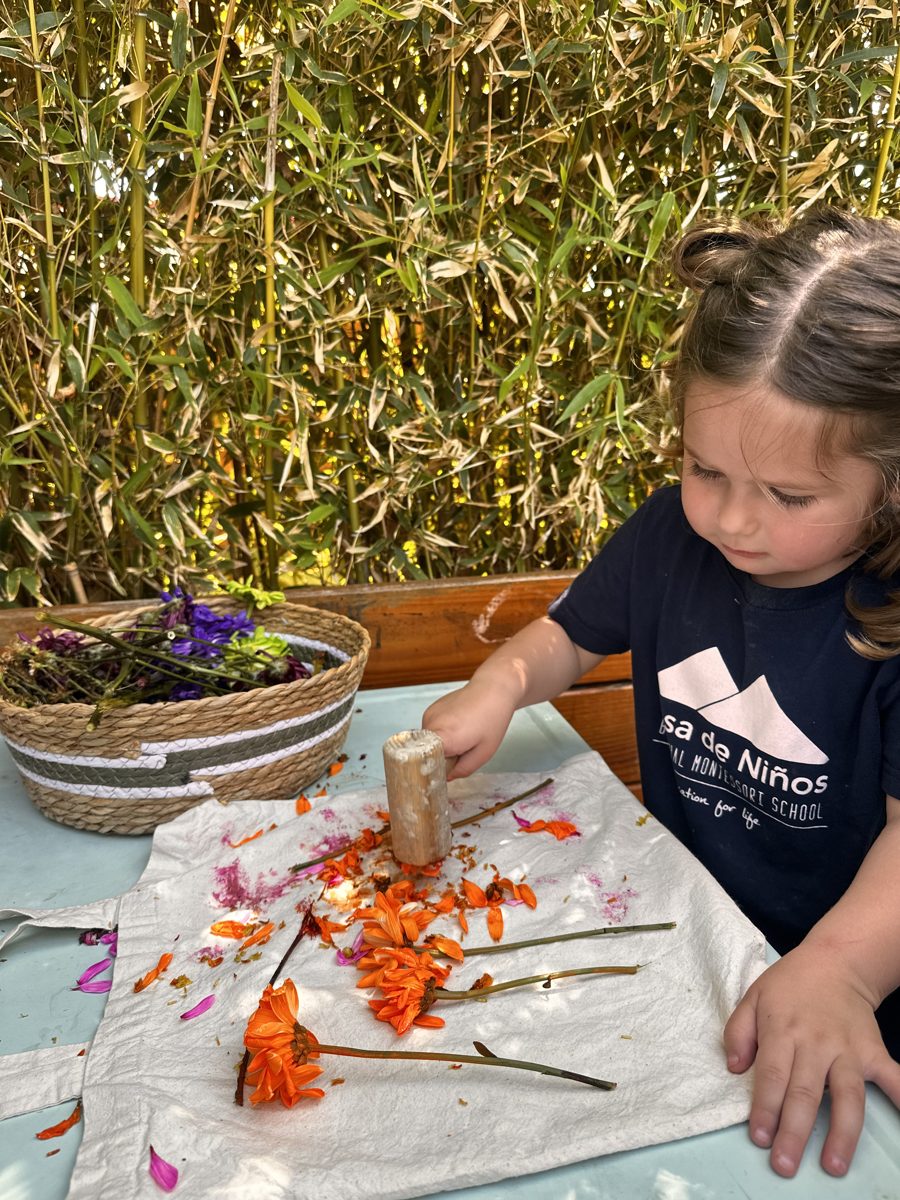
Nature study and compost
Nature study: look for flowers and tiny vegetables on the plants and count them together.
Spanish words to use: el camote, la okra, el brote, el mantillo · plantar, cubrir, barrer, contar
May mayo 2027
What to plant
- Cantaloupe · melón
- Warm-season greens · verduras de verano
- Okra · okra
- Southern peas · frijol de ojo negro
- Pepper transplants · chiles (first half)
- Sweet potato slips · camote
- Pumpkins · calabaza de Halloween
- Winter squash · calabaza
- Watermelon · sandía
Garden jobs for the family
- Harvest spring vegetables often so plants keep producing.
- Last good weeks for pepper transplants. Melons, pumpkins and okra can still go in.
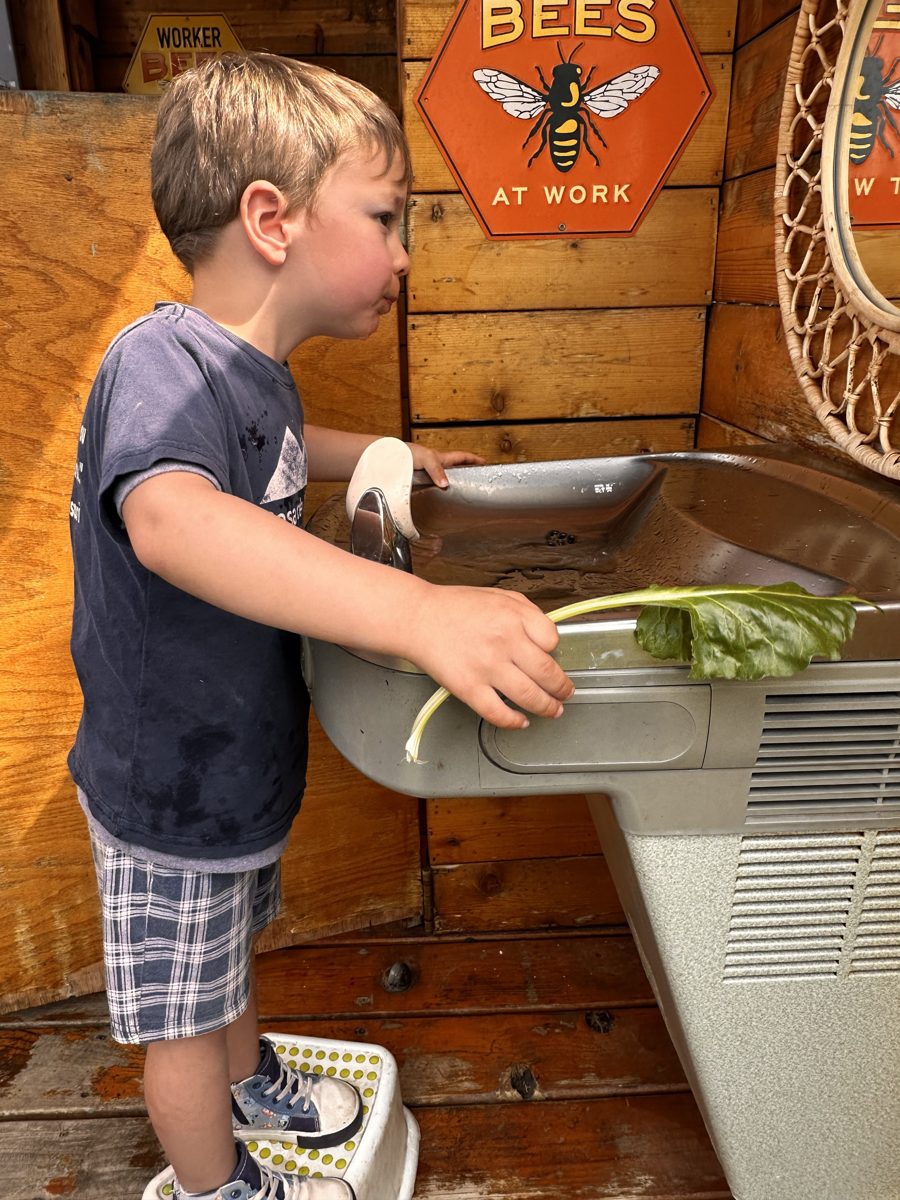
Try together this month: Pick something from the garden, wash it together and serve it at snack time.
May activities for babies, toddlers and preschoolers
Infant Nido Room
Show your baby two clean potatoes, one big and one small. Say “grande” and “pequeña” as you hold each one.
Toddlers
- Carry one big onion at a time to the basket.
- At the sink, rinse a potato under running water with the adult beside them.
- Refill the birdbath with a small pitcher.
Ages 3 to 6
- Brush back the soil the adult has loosened to find new potatoes.
- Lay harvested onions in one layer to dry.
- Bring one thing from the garden to the table and help serve it.
Nature study and compost
Nature study: draw an onion with tall leaves and one whose tops have fallen over. Tops falling over means it is ready.
Spanish words to use: la papa, la cebolla, la canasta, la palita · buscar, enjuagar, acomodar, secar
June junio 2027
What to plant
- Cantaloupe · melón (first half)
- Warm-season greens · verduras de verano
- Okra · okra
- Southern peas · frijol de ojo negro
- Sweet potato slips · camote
- Pumpkins · calabaza de Halloween
- Winter squash · calabaza (first half)
Garden jobs for the family
- Only heat lovers now: okra, southern peas, sweet potatoes and pumpkins.
- Keep the compost pile damp, like a wrung-out sponge.
Try together this month: Give your child a morning watering job with a small watering can, before the day gets hot.
June activities for babies, toddlers and preschoolers
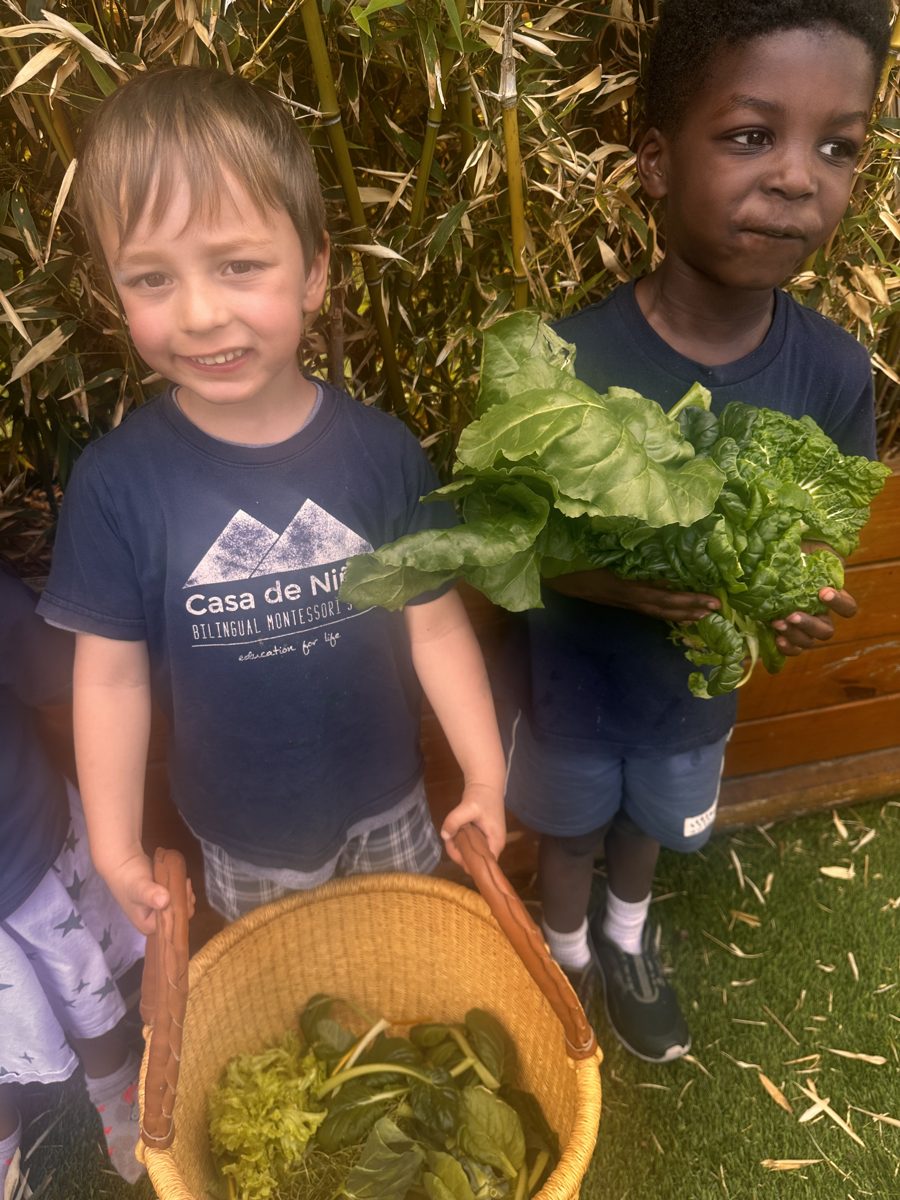
Infant Nido Room
In the cool morning, from a shaded spot, watch an adult bring the harvest to the door.
Toddlers
- Put one big potato at a time in a low basket.
- Take on a morning watering job with a small can, then put it back.
- Wipe an empty planter before it is put away.
Ages 3 to 6
- Help lift potatoes after the adult loosens the soil.
- Prepare a pot and cover okra or southern pea seeds the adult has set out.
- In the afternoon, notice which plants droop in the heat and talk about why.
Nature study and compost
Compost: carry clean vegetable trimmings in a small bowl to the compost container.
Spanish words to use: la papa, la maceta, el tazón, los restos de verduras · levantar, limpiar, sembrar, llevar
July julio 2027
What to plant
- Corn · maíz (second half)
- Eggplant transplants · berenjena (second half)
- Warm-season greens · verduras de verano
- Okra · okra (second half)
- Southern peas · frijol de ojo negro (second half)
- Pepper transplants · chiles (second half)
- Pumpkins · calabaza de Halloween (first half)
- Winter squash · calabaza (second half)
- Tomato transplants · jitomate
Garden jobs for the family
- Fall tomatoes, peppers and eggplant go in this month.
- New plants in late summer do better with some shade while they settle in.
Try together this month: Visit a farmers market and name the vegetables in English and Spanish.
July activities for babies, toddlers and preschoolers
Infant Nido Room
From a cool spot indoors, watch the light and shade move across one pot on the patio.
Toddlers
- Carry the empty watering can to the adult for the morning round.
- Pour one small, measured amount of water into a pot, then put the can back.
- Help water the new fall tomato and pepper plants early in the day.
Ages 3 to 6
- Help spread shade cloth over a frame while the adult ties it.
- Check the soil with a finger and water at the base only if it is dry.
- Keep a garden journal: draw what you see.
Nature study and compost
Nature study: look at the same pot in the morning and the afternoon, and draw where its shadow falls each time.
Spanish words to use: la sombra, la malla de sombra, la regadera, el diario · extender, revisar, regar, comparar
August agosto 2027
What to plant
- Snap and lima beans · ejotes y frijoles (second half)
- Corn · maíz (first half)
- Cucumbers · pepinos
- Eggplant transplants · berenjena (first half)
- Warm-season greens · verduras de verano (first half)
- Okra · okra (first half)
- Southern peas · frijol de ojo negro (first half)
- Pepper transplants · chiles (first half)
- Potatoes · papas (second half)
- Summer squash · calabacita
- Winter squash · calabaza (first half)
- Tomato transplants · jitomate (first half)
- Turnips · nabos (second half)
Garden jobs for the family
- Fall planting starts: beans, squash, cucumbers, and potatoes late in the month.
- Give young plants shade cover during the hottest weeks.
Try together this month: Start a garden journal. Your child can draw what grew this summer and what they want to plant next.
August activities for babies, toddlers and preschoolers
Infant Nido Room
Bring your baby to the same comfy spot each day to look at the seedling tray with you. Pause when they notice the green.
Toddlers
- Set empty pots on a tray indoors.
- Wipe the potting table with a damp cloth.
- Water young plants early, before it gets hot.
Ages 3 to 6
- Start Swiss chard in a tray, covering seeds the adult has set out, and add a label.
- Plant bean and squash seeds for fall.
- Add fresh mulch to a bed on a cool morning.
Nature study and compost
Reuse: clean the unbroken pots from spring and save them for fall plants.
Spanish words to use: la acelga, el semillero, la bandeja, el mantillo · preparar, sembrar, limpiar, reutilizar
September septiembre 2027
What to plant
- Artichoke transplants · alcachofa (second half)
- Asian greens, like bok choy · bok choy
- Snap and lima beans · ejotes y frijoles (first half)
- Beets · betabel
- Broccoli transplants · brócoli
- Brussels sprouts transplants · coles de Bruselas
- Cabbage transplants · repollo
- Carrots · zanahorias
- Cauliflower transplants · coliflor
- Swiss chard · acelga
- Collards · berza
- Garlic · ajo (second half)
- Cool-season greens · verduras de hoja (second half)
- Kale · col rizada
- Kohlrabi · colinabo
- Leeks · poros
- Lettuce · lechuga (second half)
- Mustard greens · mostaza
- Green (bunching) onions · cebollín
- English, snap and snow peas · chícharos
- Radishes · rábanos
- Spinach · espinaca (second half)
- Summer squash · calabacita (first half)
- Turnips · nabos
Garden jobs for the family
- The big cool-season planting month: broccoli, cabbage, carrots, beets, greens, peas and more.
- Mid-to-late September: start garlic, lettuce and spinach.
Try together this month: Plant radish seeds. They come up in just days, which is perfect for young gardeners.
September activities for babies, toddlers and preschoolers
Infant Nido Room
Look together at a seedling as the adult brings it out to the porch. Name what your baby sees: la hoja, la maceta.
Toddlers
- Carry the empty seedling tray back to its shelf.
- Give a newly planted pot one small pour of water.
- Pat the soil gently over new seeds with flat hands.
Ages 3 to 6
- Move a chard or kale plant into a bigger pot with the adult.
- Sow a short row of radishes or lettuce in moist soil and mark where it starts.
- Water seedbeds gently with a sprinkling can.
Nature study and compost
Nature study: draw a seedling on planting day. A week later, count its leaves and add what is new.
Spanish words to use: la plántula, la hoja, la acelga, el rábano · llevar, trasplantar, marcar, contar
October octubre 2027
What to plant
- Artichoke transplants · alcachofa (first half)
- Asian greens, like bok choy · bok choy
- Beets · betabel
- Broccoli transplants · brócoli
- Brussels sprouts transplants · coles de Bruselas
- Cabbage transplants · repollo
- Carrots · zanahorias
- Cauliflower transplants · coliflor
- Swiss chard · acelga
- Collards · berza
- Fava beans · habas
- Garlic · ajo
- Cool-season greens · verduras de hoja
- Kale · col rizada
- Kohlrabi · colinabo
- Leeks · poros
- Lettuce · lechuga
- Mustard greens · mostaza
- Onion seeds · cebolla
- Green (bunching) onions · cebollín
- English, snap and snow peas · chícharos (first half)
- Radishes · rábanos
- Shallots · chalotes
- Spinach · espinaca
- Turnips · nabos
Garden jobs for the family
- Plant garlic, shallots and onion seeds.
- October is the last month for broccoli, cabbage and cauliflower transplants.
- Start saving leaves for winter mulch and compost.
Try together this month: Plant garlic cloves together, pointy end up, and wait for green shoots in a few weeks.
October activities for babies, toddlers and preschoolers
Infant Nido Room
Hold a whole pumpkin steady and let your baby look at it. An older baby who reaches for it can pat the rind.
Toddlers
- Sweep leaves from a short stretch of path.
- Wipe the outside of a pumpkin with a damp cloth.
- Start a leaf pile as the first leaves fall.
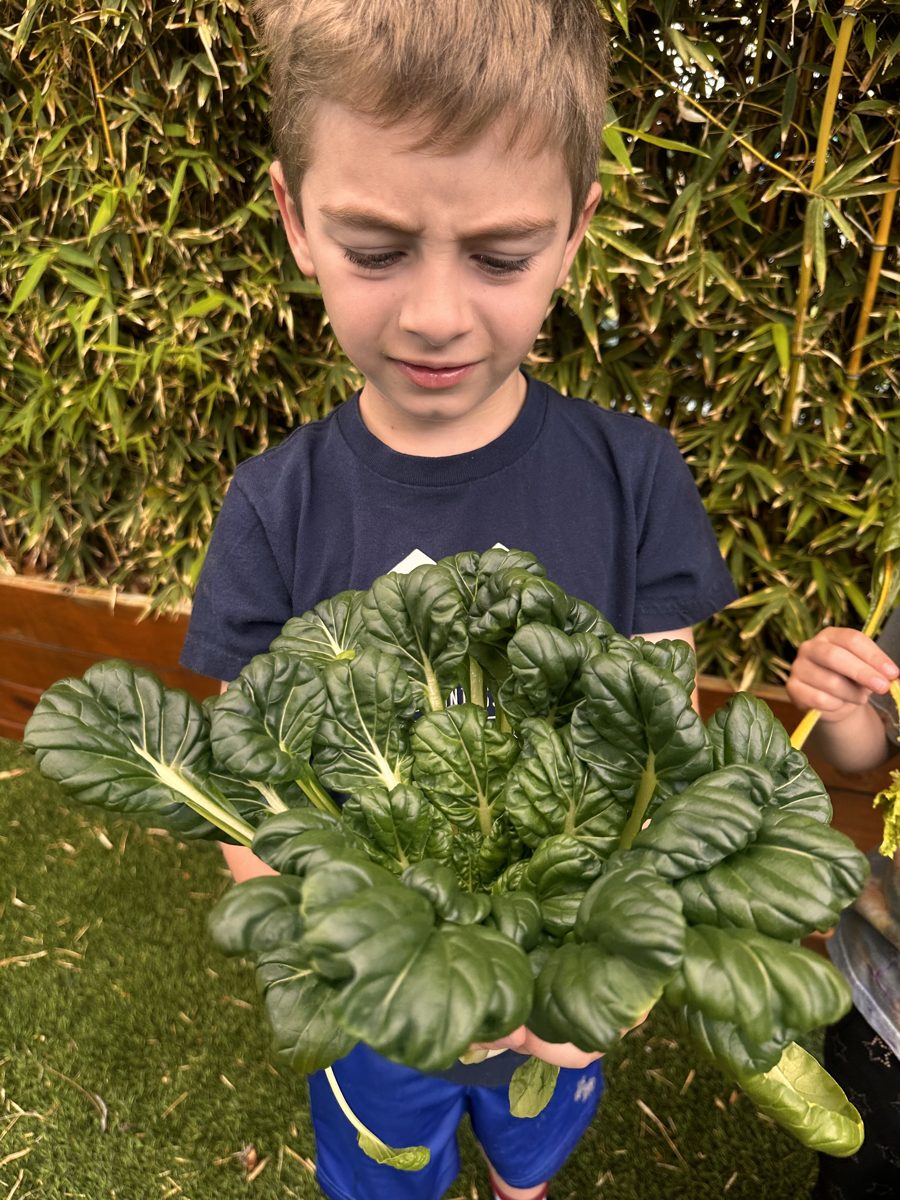
Ages 3 to 6
- Plant garlic cloves pointy end up; the adult hands out one clove at a time.
- Set a lettuce plant in a patio pot and water it in.
- Harvest fall greens and wash them for dinner.
Nature study and compost
Compost: after cooking a plain pumpkin, save the scraps for the adult to add to the compost with dry leaves.
Spanish words to use: el ajo, el diente de ajo, la calabaza, la lechuga · plantar, tapar, barrer, separar
December diciembre 2026
- Tuesday, December 1
Spanish garden word: la col rizada. “la col rizada” means the kale. Use it while you work together.
- Wednesday, December 2
For babies in the Infant Nido Room. Hold up a big, clean kale leaf and slowly turn it front to back while your baby looks. Name it: col rizada.
- Thursday, December 3
Spanish garden word: la maceta. “la maceta” means the flowerpot. Use it while you work together.
- Friday, December 4
Friday garden check. Water check: push a finger into the soil together. If it feels dry, it is time to water.
- Saturday, December 5
Garden job for the family. Feed winter vegetables every two weeks with a gentle fertilizer like fish emulsion.
- Sunday, December 6
With your child. Look through a seed catalog together and let your child choose one vegetable to grow in spring.
- Monday, December 7
Plant this week: Asian greens, like bok choy. It is planting time for this in Williamson County.
- Tuesday, December 8
New moon. Old almanac tradition: sow leafy greens and root crops around the new moon.
Spanish garden word: el paño. “el paño” means the cloth. Use it while you work together.
- Wednesday, December 9
For toddlers. Wipe the outside of an empty planter with a damp cloth.
- Thursday, December 10
Spanish garden word: la helada. “la helada” means the frost. Use it while you work together.
- Friday, December 11
Friday garden check. Look for something new in the garden, like a sprout, a flower or a bug, and name it together.
- Saturday, December 12
Garden job for the family. When the low drops below 28°F, cover plants with frost cloth and secure the edges.
- Sunday, December 13
With your child. Set a kale or lettuce plant into a prepared pot and press the soil around it.
- Monday, December 14
Plant this week: Cool-season greens. It is planting time for this in Williamson County.
- Tuesday, December 15
Spanish garden word: limpiar. “limpiar” means to clean. Use it while you work together.
- Wednesday, December 16
For toddlers. Carry the light frost cloth to the adult who is covering the greens.
- Thursday, December 17
Spanish garden word: trasplantar. “trasplantar” means to transplant. Use it while you work together.
- Friday, December 18
Friday garden check. Wipe the garden tools with a cloth and help your child put each one back in its place.
- Saturday, December 19
Garden job for the family. Turn the compost on mild days. Pull small weeds; clean and oil tools.
- Sunday, December 20
With your child. Help unfold the frost cloth and set rocks along the edges.
- Monday, December 21
First day of winter. Step outside together and notice the light and the plants.
Plant this week: Lettuce. It is planting time for this in Williamson County.
- Tuesday, December 22
Spanish garden word: cubrir. “cubrir” means to cover. Use it while you work together.
- Wednesday, December 23
Full moon, the Cold Moon. Take an evening walk to see the moon and check on the garden.
For toddlers. Wipe garden tools and hang each one in its place.
- Thursday, December 24
Spanish garden word: observar. “observar” means to observe. Use it while you work together.
- Friday, December 25
Friday garden check. Visit one plant each Friday and talk about how it has changed since last week.
- Saturday, December 26
Garden job for the family. Start broccoli, cabbage, cauliflower, kale and collard seeds in trays to plant out in January. Order seed potatoes.
- Sunday, December 27
With your child. Push a finger into the soil to check if it is dry before watering.
- Monday, December 28
Plant this week: Radishes. It is planting time for this in Williamson County.
- Tuesday, December 29
Spanish garden word: la col rizada. “la col rizada” means the kale. Use it while you work together.
- Wednesday, December 30
For babies in the Infant Nido Room. Hold up a big, clean kale leaf and slowly turn it front to back while your baby looks. Name it: col rizada.
- Thursday, December 31
Spanish garden word: la maceta. “la maceta” means the flowerpot. Use it while you work together.
January enero 2027
- Friday, January 1
Start planting: Artichoke crowns, asparagus crowns, fava beans and onion transplants. Planting time begins in Williamson County.
Friday garden check. Water check: push a finger into the soil together. If it feels dry, it is time to water.
- Saturday, January 2
Garden job for the family. Set out onion transplants in January and early February.
- Sunday, January 3
With your child. Plant onion sets in a pot. Small fingers can press each one in, pointy end up.
- Monday, January 4
Plant this week: Artichoke crowns. It is planting time for this in Williamson County.
- Tuesday, January 5
Spanish garden word: el cepillo. “el cepillo” means the brush. Use it while you work together.
- Wednesday, January 6
For babies in the Infant Nido Room. Let your baby watch from a blanket nearby while you wipe a small watering can. Name each thing: regadera, agua, tierra.
- Thursday, January 7
New moon. Old almanac tradition: sow leafy greens and root crops around the new moon.
Spanish garden word: la regadera. “la regadera” means the watering can. Use it while you work together.
- Friday, January 8
Friday garden check. Look for something new in the garden, like a sprout, a flower or a bug, and name it together.
- Saturday, January 9
Garden job for the family. From mid-January, plant broccoli, cabbage and cauliflower transplants and the seedlings started in December.
- Sunday, January 10
With your child. Set onion plants into holes the adult has made, and press the soil around them.
- Monday, January 11
Plant this week: Asian greens, like bok choy. It is planting time for this in Williamson County.
- Tuesday, January 12
Spanish garden word: la cebolla. “la cebolla” means the onion. Use it while you work together.
- Wednesday, January 13
For toddlers. Scrub an empty, unbreakable pot with a soft brush.
- Thursday, January 14
Spanish garden word: la etiqueta. “la etiqueta” means the label. Use it while you work together.
- Friday, January 15
Friday garden check. Wipe the garden tools with a cloth and help your child put each one back in its place.
- Saturday, January 16
Start planting: Beets, broccoli transplants, cabbage transplants, carrots, cauliflower transplants, Swiss chard, collards, kale, kohlrabi, leeks, mustard greens, English, snap and snow peas and turnips. Planting time begins in Williamson County.
Garden job for the family. Keep frost cloth handy. January and February can still bring hard freezes.
- Sunday, January 17
With your child. Water new broccoli and cabbage plants at the base, from mid-January.
- Monday, January 18
Plant this week: Asparagus crowns. It is planting time for this in Williamson County.
- Tuesday, January 19
Spanish garden word: cepillar. “cepillar” means to brush. Use it while you work together.
- Wednesday, January 20
For toddlers. Carry seedling trays to the garden with two hands.
- Thursday, January 21
Spanish garden word: regar. “regar” means to water. Use it while you work together.
- Friday, January 22
Full moon, the Wolf Moon. Take an evening walk to see the moon and check on the garden.
Friday garden check. Visit one plant each Friday and talk about how it has changed since last week.
- Saturday, January 23
Garden job for the family. Family garden time: water, pull a few weeds and check on what you planted.
- Sunday, January 24
With your child. After a cold night, lift the frost cloth together and see what changed.
- Monday, January 25
Plant this week: Beets. It is planting time for this in Williamson County.
- Tuesday, January 26
Spanish garden word: presionar. “presionar” means to press. Use it while you work together.
- Wednesday, January 27
For toddlers. Pour a little water at the base of a lettuce plant.
- Thursday, January 28
Spanish garden word: etiquetar. “etiquetar” means to label. Use it while you work together.
- Saturday, January 30
Garden job for the family. Family garden time: water, pull a few weeds and check on what you planted.
- Sunday, January 31
Last day to plant: Fava beans. After this, wait for the next season.
With your child. Nature study: pick one tree to visit every week this winter. Stand in the same spot and look for anything new.
February febrero 2027
- Monday, February 1
Start planting: Potatoes. Planting time begins in Williamson County.
Plant this week: Artichoke crowns. It is planting time for this in Williamson County.
- Tuesday, February 2
Spanish garden word: la papa. “la papa” means the potato. Use it while you work together.
- Wednesday, February 3
For babies in the Infant Nido Room. Show your baby a whole onion. Turn it slowly and name it: la cebolla.
- Thursday, February 4
Spanish garden word: la bandeja. “la bandeja” means the tray. Use it while you work together.
- Friday, February 5
Friday garden check. Water check: push a finger into the soil together. If it feels dry, it is time to water.
- Saturday, February 6
New moon. Old almanac tradition: sow leafy greens and root crops around the new moon.
Garden job for the family. Plant potatoes from late January through February.
- Sunday, February 7
With your child. Look at a seed potato together and count its "eyes." Each eye can grow a new plant.
- Monday, February 8
Plant this week: Asian greens, like bok choy. It is planting time for this in Williamson County.
- Tuesday, February 9
Spanish garden word: la plántula. “la plántula” means the seedling. Use it while you work together.
- Wednesday, February 10
For toddlers. Set empty pots on a tray for the adult.
- Thursday, February 11
Spanish garden word: el lápiz. “el lápiz” means the pencil. Use it while you work together.
- Friday, February 12
Friday garden check. Look for something new in the garden, like a sprout, a flower or a bug, and name it together.
- Saturday, February 13
Garden job for the family. February is the last month for broccoli, cabbage and cauliflower transplants.
- Sunday, February 14
With your child. Drop seed potatoes into the row and cover them with soil.
- Monday, February 15
Last day to plant: Asparagus crowns, onion transplants and English, snap and snow peas. After this, wait for the next season.
Plant this week: Asparagus crowns. It is planting time for this in Williamson County.
- Tuesday, February 16
Spanish garden word: colocar. “colocar” means to place. Use it while you work together.
- Wednesday, February 17
For toddlers. Give a newly planted bed a small pour of water.
- Thursday, February 18
Spanish garden word: cubrir. “cubrir” means to cover. Use it while you work together.
- Friday, February 19
Friday garden check. Wipe the garden tools with a cloth and help your child put each one back in its place.
- Saturday, February 20
Full moon, the Snow Moon. Take an evening walk to see the moon and check on the garden.
Garden job for the family. Work compost into beds so they are ready for spring planting.
- Sunday, February 21
With your child. Count the “eyes” on a seed potato before planting.
- Monday, February 22
Plant this week: Broccoli transplants. It is planting time for this in Williamson County.
- Tuesday, February 23
Spanish garden word: contar. “contar” means to count. Use it while you work together.
- Wednesday, February 24
For toddlers. Carry the harvest basket for the last lettuce leaves.
- Thursday, February 25
Spanish garden word: dibujar. “dibujar” means to draw. Use it while you work together.
- Friday, February 26
Friday garden check. Visit one plant each Friday and talk about how it has changed since last week.
- Saturday, February 27
Garden job for the family. Family garden time: water, pull a few weeds and check on what you planted.
- Sunday, February 28
Last day to plant: Artichoke crowns, asian greens, like bok choy, broccoli transplants, cabbage transplants, cauliflower transplants, collards, kale, leeks, potatoes and spinach. After this, wait for the next season.
With your child. Spread compost on the beds with a small shovel.
March marzo 2027
- Monday, March 1
Start planting: Snap and lima beans, corn, cucumbers, summer squash and tomato transplants. Planting time begins in Williamson County.
Plant this week: Snap and lima beans. It is planting time for this in Williamson County.
- Tuesday, March 2
Spanish garden word: el tomate. “el tomate” means the tomato. Use it while you work together.
- Wednesday, March 3
For babies in the Infant Nido Room. From the porch, watch an adult water a new plant, and listen together to the water on the soil.
- Thursday, March 4
Average last freeze, Williamson County. Watch for a late cold snap before setting out tomatoes.
Spanish garden word: el frijol. “el frijol” means the bean. Use it while you work together.
- Friday, March 5
Friday garden check. Water check: push a finger into the soil together. If it feels dry, it is time to water.
- Saturday, March 6
Garden job for the family. Warm-season planting begins: tomatoes, beans, squash, cucumbers and corn.
- Sunday, March 7
With your child. Plant big seeds like beans or squash. They are easy for small hands to hold and place.
- Monday, March 8
Plant this week: Beets. It is planting time for this in Williamson County.
New moon. Old almanac tradition: sow leafy greens and root crops around the new moon.
- Tuesday, March 9
Spanish garden word: la flor. “la flor” means the flower. Use it while you work together.
- Wednesday, March 10
For toddlers. Water the base of one new plant with a small can.
- Thursday, March 11
Spanish garden word: la lombriz. “la lombriz” means the worm. Use it while you work together.
- Friday, March 12
Friday garden check. Look for something new in the garden, like a sprout, a flower or a bug, and name it together.
- Saturday, March 13
Garden job for the family. Finish harvesting winter greens before the heat makes them bitter and go to seed.
- Sunday, March 14
With your child. After the last freeze, help plant a tomato in a prepared hole and water it in.
- Monday, March 15
Last day to plant: Carrots, cool-season greens, kohlrabi and lettuce. After this, wait for the next season.
Plant this week: Carrots. It is planting time for this in Williamson County.
- Tuesday, March 16
Start planting: Cantaloupe, eggplant transplants, warm-season greens, southern peas, pepper transplants, pumpkins and winter squash. Planting time begins in Williamson County.
Spanish garden word: trasplantar. “trasplantar” means to transplant. Use it while you work together.
- Wednesday, March 17
For toddlers. Put lettuce leaves the adult picked into the harvest basket.
- Thursday, March 18
Spanish garden word: regar. “regar” means to water. Use it while you work together.
- Friday, March 19
Friday garden check. Wipe the garden tools with a cloth and help your child put each one back in its place.
- Saturday, March 20
First day of spring. Step outside together and notice the light and the plants.
Garden job for the family. Family garden time: water, pull a few weeds and check on what you planted.
- Sunday, March 21
With your child. Cover bean and squash seeds the adult has set in a row.
- Monday, March 22
Plant this week: Swiss chard. It is planting time for this in Williamson County.
Full moon, the Worm Moon. Take an evening walk to see the moon and check on the garden.
- Tuesday, March 23
Spanish garden word: cubrir. “cubrir” means to cover. Use it while you work together.
- Wednesday, March 24
For toddlers. When you find a worm, watch it for a minute, then put it back gently.
- Thursday, March 25
Spanish garden word: mirar. “mirar” means to look. Use it while you work together.
- Friday, March 26
Friday garden check. Visit one plant each Friday and talk about how it has changed since last week.
- Saturday, March 27
Garden job for the family. Family garden time: water, pull a few weeds and check on what you planted.
- Sunday, March 28
With your child. Draw plant labels and push them into the soil.
- Monday, March 29
Plant this week: Corn. It is planting time for this in Williamson County.
- Tuesday, March 30
Spanish garden word: el tomate. “el tomate” means the tomato. Use it while you work together.
- Wednesday, March 31
Last day to plant: Beets, mustard greens, radishes and turnips. After this, wait for the next season.
For babies in the Infant Nido Room. From the porch, watch an adult water a new plant, and listen together to the water on the soil.
April abril 2027
- Thursday, April 1
Start planting: Okra and watermelon. Planting time begins in Williamson County.
Spanish garden word: el camote. “el camote” means the sweet potato. Use it while you work together.
- Friday, April 2
Friday garden check. Water check: push a finger into the soil together. If it feels dry, it is time to water.
- Saturday, April 3
Garden job for the family. Plant peppers, eggplant, okra, melons and sweet potatoes as the soil warms.
- Sunday, April 4
With your child. Watch for flowers on the squash and tomatoes. Talk about how each flower can become a vegetable.
- Monday, April 5
Plant this week: Snap and lima beans. It is planting time for this in Williamson County.
- Tuesday, April 6
New moon. Old almanac tradition: sow leafy greens and root crops around the new moon.
Spanish garden word: la okra. “la okra” means the okra. Use it while you work together.
- Wednesday, April 7
For babies in the Infant Nido Room. Hold your baby near flowers and herbs to smell, and let them touch a soft leaf like basil. Name it: albahaca.
- Thursday, April 8
Spanish garden word: el brote. “el brote” means the sprout. Use it while you work together.
- Friday, April 9
Friday garden check. Look for something new in the garden, like a sprout, a flower or a bug, and name it together.
- Saturday, April 10
Garden job for the family. Add mulch around plants to hold moisture before the hot months.
- Sunday, April 11
With your child. Cover okra seeds the adult has set out, and label the row.
- Monday, April 12
Plant this week: Cantaloupe. It is planting time for this in Williamson County.
- Tuesday, April 13
Spanish garden word: el mantillo. “el mantillo” means the mulch. Use it while you work together.
- Wednesday, April 14
For toddlers. Carry an empty basket out for the last lettuce harvest.
- Thursday, April 15
Last day to plant: Corn. After this, wait for the next season.
Spanish garden word: plantar. “plantar” means to plant. Use it while you work together.
- Friday, April 16
Start planting: Sweet potato slips. Planting time begins in Williamson County.
Friday garden check. Wipe the garden tools with a cloth and help your child put each one back in its place.
- Saturday, April 17
Garden job for the family. Family garden time: water, pull a few weeds and check on what you planted.
- Sunday, April 18
With your child. Late in the month, help plant sweet potato slips.
- Monday, April 19
Plant this week: Swiss chard. It is planting time for this in Williamson County.
- Tuesday, April 20
Full moon, the Pink Moon. Take an evening walk to see the moon and check on the garden.
Spanish garden word: cubrir. “cubrir” means to cover. Use it while you work together.
- Wednesday, April 21
For toddlers. Sweep the patio after potting.
- Thursday, April 22
Spanish garden word: barrer. “barrer” means to sweep. Use it while you work together.
- Friday, April 23
Friday garden check. Visit one plant each Friday and talk about how it has changed since last week.
- Saturday, April 24
Garden job for the family. Family garden time: water, pull a few weeds and check on what you planted.
- Sunday, April 25
With your child. Water tomatoes and peppers at the base, not on the leaves.
- Monday, April 26
Plant this week: Cucumbers. It is planting time for this in Williamson County.
- Tuesday, April 27
Spanish garden word: contar. “contar” means to count. Use it while you work together.
- Wednesday, April 28
For toddlers. Spread mulch around plants with their hands.
- Thursday, April 29
Spanish garden word: el camote. “el camote” means the sweet potato. Use it while you work together.
- Friday, April 30
Last day to plant: Snap and lima beans, Swiss chard, cucumbers, eggplant transplants, summer squash and tomato transplants. After this, wait for the next season.
May mayo 2027
- Saturday, May 1
Garden job for the family. Harvest spring vegetables often so plants keep producing.
- Sunday, May 2
With your child. Pick something from the garden, wash it together and serve it at snack time.
- Monday, May 3
Plant this week: Cantaloupe. It is planting time for this in Williamson County.
- Tuesday, May 4
Spanish garden word: la papa. “la papa” means the potato. Use it while you work together.
- Wednesday, May 5
For babies in the Infant Nido Room. Show your baby two clean potatoes, one big and one small. Say “grande” and “pequeña” as you hold each one.
- Thursday, May 6
New moon. Old almanac tradition: sow leafy greens and root crops around the new moon.
Spanish garden word: la cebolla. “la cebolla” means the onion. Use it while you work together.
- Friday, May 7
Friday garden check. Water check: push a finger into the soil together. If it feels dry, it is time to water.
- Saturday, May 8
Garden job for the family. Last good weeks for pepper transplants. Melons, pumpkins and okra can still go in.
- Sunday, May 9
With your child. Brush back the soil the adult has loosened to find new potatoes.
- Monday, May 10
Plant this week: Warm-season greens. It is planting time for this in Williamson County.
- Tuesday, May 11
Spanish garden word: la canasta. “la canasta” means the basket. Use it while you work together.
- Wednesday, May 12
For toddlers. Carry one big onion at a time to the basket.
- Thursday, May 13
Spanish garden word: la palita. “la palita” means the little shovel. Use it while you work together.
- Friday, May 14
Friday garden check. Look for something new in the garden, like a sprout, a flower or a bug, and name it together.
- Saturday, May 15
Last day to plant: Pepper transplants. After this, wait for the next season.
Garden job for the family. Family garden time: water, pull a few weeds and check on what you planted.
- Sunday, May 16
With your child. Lay harvested onions in one layer to dry.
- Monday, May 17
Plant this week: Okra. It is planting time for this in Williamson County.
- Tuesday, May 18
Spanish garden word: buscar. “buscar” means to look for. Use it while you work together.
- Wednesday, May 19
For toddlers. At the sink, rinse a potato under running water with the adult beside them.
- Thursday, May 20
Full moon, the Flower Moon. Take an evening walk to see the moon and check on the garden.
Spanish garden word: enjuagar. “enjuagar” means to rinse. Use it while you work together.
- Friday, May 21
Friday garden check. Wipe the garden tools with a cloth and help your child put each one back in its place.
- Saturday, May 22
Garden job for the family. Family garden time: water, pull a few weeds and check on what you planted.
- Sunday, May 23
With your child. Bring one thing from the garden to the table and help serve it.
- Monday, May 24
Plant this week: Southern peas. It is planting time for this in Williamson County.
- Tuesday, May 25
Spanish garden word: acomodar. “acomodar” means to arrange. Use it while you work together.
- Wednesday, May 26
For toddlers. Refill the birdbath with a small pitcher.
- Thursday, May 27
Spanish garden word: secar. “secar” means to dry. Use it while you work together.
- Friday, May 28
Friday garden check. Visit one plant each Friday and talk about how it has changed since last week.
- Saturday, May 29
Garden job for the family. Family garden time: water, pull a few weeds and check on what you planted.
- Sunday, May 30
With your child. Nature study: draw an onion with tall leaves and one whose tops have fallen over. Tops falling over means it is ready.
- Monday, May 31
Last day to plant: Watermelon. After this, wait for the next season.
Plant this week: Sweet potato slips. It is planting time for this in Williamson County.
June junio 2027
- Tuesday, June 1
Spanish garden word: la papa. “la papa” means the potato. Use it while you work together.
- Wednesday, June 2
For babies in the Infant Nido Room. In the cool morning, from a shaded spot, watch an adult bring the harvest to the door.
- Thursday, June 3
Spanish garden word: la maceta. “la maceta” means the flowerpot. Use it while you work together.
- Friday, June 4
New moon. Old almanac tradition: sow leafy greens and root crops around the new moon.
Friday garden check. Water check: push a finger into the soil together. If it feels dry, it is time to water.
- Saturday, June 5
Garden job for the family. Only heat lovers now: okra, southern peas, sweet potatoes and pumpkins.
- Sunday, June 6
With your child. Give your child a morning watering job with a small watering can, before the day gets hot.
- Monday, June 7
Plant this week: Cantaloupe. It is planting time for this in Williamson County.
- Tuesday, June 8
Spanish garden word: el tazón. “el tazón” means the bowl. Use it while you work together.
- Wednesday, June 9
For toddlers. Put one big potato at a time in a low basket.
- Thursday, June 10
Spanish garden word: los restos de verduras. “los restos de verduras” means the vegetable scraps. Use it while you work together.
- Friday, June 11
Friday garden check. Look for something new in the garden, like a sprout, a flower or a bug, and name it together.
- Saturday, June 12
Garden job for the family. Keep the compost pile damp, like a wrung-out sponge.
- Sunday, June 13
With your child. Help lift potatoes after the adult loosens the soil.
- Monday, June 14
Plant this week: Warm-season greens. It is planting time for this in Williamson County.
- Tuesday, June 15
Last day to plant: Cantaloupe and winter squash. After this, wait for the next season.
Spanish garden word: levantar. “levantar” means to lift. Use it while you work together.
- Wednesday, June 16
For toddlers. Take on a morning watering job with a small can, then put it back.
- Thursday, June 17
Spanish garden word: limpiar. “limpiar” means to clean. Use it while you work together.
- Friday, June 18
Full moon, the Strawberry Moon. Take an evening walk to see the moon and check on the garden.
Friday garden check. Wipe the garden tools with a cloth and help your child put each one back in its place.
- Saturday, June 19
Garden job for the family. Family garden time: water, pull a few weeds and check on what you planted.
- Sunday, June 20
With your child. Prepare a pot and cover okra or southern pea seeds the adult has set out.
- Monday, June 21
First day of summer. Step outside together and notice the light and the plants.
Plant this week: Southern peas. It is planting time for this in Williamson County.
- Tuesday, June 22
Spanish garden word: sembrar. “sembrar” means to sow. Use it while you work together.
- Wednesday, June 23
For toddlers. Wipe an empty planter before it is put away.
- Thursday, June 24
Spanish garden word: llevar. “llevar” means to carry. Use it while you work together.
- Friday, June 25
Friday garden check. Visit one plant each Friday and talk about how it has changed since last week.
- Saturday, June 26
Garden job for the family. Family garden time: water, pull a few weeds and check on what you planted.
- Sunday, June 27
With your child. In the afternoon, notice which plants droop in the heat and talk about why.
- Monday, June 28
Plant this week: Sweet potato slips. It is planting time for this in Williamson County.
- Tuesday, June 29
Spanish garden word: la papa. “la papa” means the potato. Use it while you work together.
- Wednesday, June 30
Last day to plant: Sweet potato slips. After this, wait for the next season.
For babies in the Infant Nido Room. In the cool morning, from a shaded spot, watch an adult bring the harvest to the door.
July julio 2027
- Thursday, July 1
Start planting: Tomato transplants. Planting time begins in Williamson County.
Spanish garden word: la sombra. “la sombra” means the shade. Use it while you work together.
- Friday, July 2
Friday garden check. Water check: push a finger into the soil together. If it feels dry, it is time to water.
- Saturday, July 3
New moon. Old almanac tradition: sow leafy greens and root crops around the new moon.
Garden job for the family. Fall tomatoes, peppers and eggplant go in this month.
- Sunday, July 4
With your child. Visit a farmers market and name the vegetables in English and Spanish.
- Monday, July 5
Plant this week: Warm-season greens. It is planting time for this in Williamson County.
- Tuesday, July 6
Spanish garden word: la malla de sombra. “la malla de sombra” means the shade cloth. Use it while you work together.
- Wednesday, July 7
For babies in the Infant Nido Room. From a cool spot indoors, watch the light and shade move across one pot on the patio.
- Thursday, July 8
Spanish garden word: la regadera. “la regadera” means the watering can. Use it while you work together.
- Friday, July 9
Friday garden check. Look for something new in the garden, like a sprout, a flower or a bug, and name it together.
- Saturday, July 10
Garden job for the family. New plants in late summer do better with some shade while they settle in.
- Sunday, July 11
With your child. Help spread shade cloth over a frame while the adult ties it.
- Monday, July 12
Plant this week: Pumpkins. It is planting time for this in Williamson County.
- Tuesday, July 13
Spanish garden word: el diario. “el diario” means the journal. Use it while you work together.
- Wednesday, July 14
For toddlers. Carry the empty watering can to the adult for the morning round.
- Thursday, July 15
Last day to plant: Pumpkins. After this, wait for the next season.
Spanish garden word: extender. “extender” means to spread out. Use it while you work together.
- Friday, July 16
Start planting: Corn, eggplant transplants, okra, southern peas, pepper transplants and winter squash. Planting time begins in Williamson County.
Friday garden check. Wipe the garden tools with a cloth and help your child put each one back in its place.
- Saturday, July 17
Garden job for the family. Family garden time: water, pull a few weeds and check on what you planted.
- Sunday, July 18
Full moon, the Buck Moon. Take an evening walk to see the moon and check on the garden.
With your child. Check the soil with a finger and water at the base only if it is dry.
- Monday, July 19
Plant this week: Warm-season greens. It is planting time for this in Williamson County.
- Tuesday, July 20
Spanish garden word: revisar. “revisar” means to check. Use it while you work together.
- Wednesday, July 21
For toddlers. Pour one small, measured amount of water into a pot, then put the can back.
- Thursday, July 22
Spanish garden word: regar. “regar” means to water. Use it while you work together.
- Friday, July 23
Friday garden check. Visit one plant each Friday and talk about how it has changed since last week.
- Saturday, July 24
Garden job for the family. Family garden time: water, pull a few weeds and check on what you planted.
- Sunday, July 25
With your child. Keep a garden journal: draw what you see.
- Monday, July 26
Plant this week: Okra. It is planting time for this in Williamson County.
- Tuesday, July 27
Spanish garden word: comparar. “comparar” means to compare. Use it while you work together.
- Wednesday, July 28
For toddlers. Help water the new fall tomato and pepper plants early in the day.
- Thursday, July 29
Spanish garden word: la sombra. “la sombra” means the shade. Use it while you work together.
- Saturday, July 31
Garden job for the family. Family garden time: water, pull a few weeds and check on what you planted.
August agosto 2027
- Sunday, August 1
Start planting: Cucumbers and summer squash. Planting time begins in Williamson County.
With your child. Start a garden journal. Your child can draw what grew this summer and what they want to plant next.
- Monday, August 2
Plant this week: Corn. It is planting time for this in Williamson County.
New moon. Old almanac tradition: sow leafy greens and root crops around the new moon.
- Tuesday, August 3
Spanish garden word: la acelga. “la acelga” means the Swiss chard. Use it while you work together.
- Wednesday, August 4
For babies in the Infant Nido Room. Bring your baby to the same comfy spot each day to look at the seedling tray with you. Pause when they notice the green.
- Thursday, August 5
Spanish garden word: el semillero. “el semillero” means the seed tray. Use it while you work together.
- Friday, August 6
Friday garden check. Water check: push a finger into the soil together. If it feels dry, it is time to water.
- Saturday, August 7
Garden job for the family. Fall planting starts: beans, squash, cucumbers, and potatoes late in the month.
- Sunday, August 8
With your child. Start Swiss chard in a tray, covering seeds the adult has set out, and add a label.
- Monday, August 9
Plant this week: Cucumbers. It is planting time for this in Williamson County.
- Tuesday, August 10
Spanish garden word: la bandeja. “la bandeja” means the tray. Use it while you work together.
- Wednesday, August 11
For toddlers. Set empty pots on a tray indoors.
- Thursday, August 12
Spanish garden word: el mantillo. “el mantillo” means the mulch. Use it while you work together.
- Friday, August 13
Friday garden check. Look for something new in the garden, like a sprout, a flower or a bug, and name it together.
- Saturday, August 14
Garden job for the family. Give young plants shade cover during the hottest weeks.
- Sunday, August 15
Last day to plant: Corn, eggplant transplants, warm-season greens, okra, southern peas, pepper transplants, winter squash and tomato transplants. After this, wait for the next season.
With your child. Plant bean and squash seeds for fall.
- Monday, August 16
Start planting: Snap and lima beans, potatoes and turnips. Planting time begins in Williamson County.
Plant this week: Potatoes. It is planting time for this in Williamson County.
- Tuesday, August 17
Full moon, the Sturgeon Moon. Take an evening walk to see the moon and check on the garden.
Spanish garden word: preparar. “preparar” means to prepare. Use it while you work together.
- Wednesday, August 18
For toddlers. Wipe the potting table with a damp cloth.
- Thursday, August 19
Spanish garden word: sembrar. “sembrar” means to sow. Use it while you work together.
- Friday, August 20
Friday garden check. Wipe the garden tools with a cloth and help your child put each one back in its place.
- Saturday, August 21
Garden job for the family. Family garden time: water, pull a few weeds and check on what you planted.
- Sunday, August 22
With your child. Add fresh mulch to a bed on a cool morning.
- Monday, August 23
Plant this week: Summer squash. It is planting time for this in Williamson County.
- Tuesday, August 24
Spanish garden word: limpiar. “limpiar” means to clean. Use it while you work together.
- Wednesday, August 25
For toddlers. Water young plants early, before it gets hot.
- Thursday, August 26
Spanish garden word: reutilizar. “reutilizar” means to reuse. Use it while you work together.
- Friday, August 27
Friday garden check. Visit one plant each Friday and talk about how it has changed since last week.
- Saturday, August 28
Garden job for the family. Family garden time: water, pull a few weeds and check on what you planted.
- Sunday, August 29
With your child. Reuse: clean the unbroken pots from spring and save them for fall plants.
- Monday, August 30
Plant this week: Turnips. It is planting time for this in Williamson County.
- Tuesday, August 31
Last day to plant: Cucumbers and potatoes. After this, wait for the next season.
New moon. Old almanac tradition: sow leafy greens and root crops around the new moon.
Spanish garden word: la acelga. “la acelga” means the Swiss chard. Use it while you work together.
September septiembre 2027
- Wednesday, September 1
Start planting: Asian greens, like bok choy, beets, broccoli transplants, brussels sprouts transplants, cabbage transplants, carrots, cauliflower transplants, Swiss chard, collards, kale, kohlrabi, leeks, mustard greens, green (bunching) onions, English, snap and snow peas and radishes. Planting time begins in Williamson County.
For babies in the Infant Nido Room. Look together at a seedling as the adult brings it out to the porch. Name what your baby sees: la hoja, la maceta.
- Thursday, September 2
Spanish garden word: la plántula. “la plántula” means the seedling. Use it while you work together.
- Friday, September 3
Friday garden check. Water check: push a finger into the soil together. If it feels dry, it is time to water.
- Saturday, September 4
Garden job for the family. The big cool-season planting month: broccoli, cabbage, carrots, beets, greens, peas and more.
- Sunday, September 5
With your child. Plant radish seeds. They come up in just days, which is perfect for young gardeners.
- Monday, September 6
Plant this week: Asian greens, like bok choy. It is planting time for this in Williamson County.
- Tuesday, September 7
Spanish garden word: la hoja. “la hoja” means the leaf. Use it while you work together.
- Wednesday, September 8
For toddlers. Carry the empty seedling tray back to its shelf.
- Thursday, September 9
Spanish garden word: la acelga. “la acelga” means the Swiss chard. Use it while you work together.
- Friday, September 10
Friday garden check. Look for something new in the garden, like a sprout, a flower or a bug, and name it together.
- Saturday, September 11
Garden job for the family. Mid-to-late September: start garlic, lettuce and spinach.
- Sunday, September 12
With your child. Move a chard or kale plant into a bigger pot with the adult.
- Monday, September 13
Plant this week: Snap and lima beans. It is planting time for this in Williamson County.
- Tuesday, September 14
Spanish garden word: el rábano. “el rábano” means the radish. Use it while you work together.
- Wednesday, September 15
Last day to plant: Snap and lima beans and summer squash. After this, wait for the next season.
Full moon, the Harvest Moon. Take an evening walk to see the moon and check on the garden.
For toddlers. Give a newly planted pot one small pour of water.
- Thursday, September 16
Start planting: Artichoke transplants, garlic, cool-season greens, lettuce and spinach. Planting time begins in Williamson County.
Spanish garden word: llevar. “llevar” means to carry. Use it while you work together.
- Friday, September 17
Friday garden check. Wipe the garden tools with a cloth and help your child put each one back in its place.
- Saturday, September 18
Garden job for the family. Family garden time: water, pull a few weeds and check on what you planted.
- Sunday, September 19
With your child. Sow a short row of radishes or lettuce in moist soil and mark where it starts.
- Monday, September 20
Plant this week: Beets. It is planting time for this in Williamson County.
- Tuesday, September 21
Spanish garden word: trasplantar. “trasplantar” means to transplant. Use it while you work together.
- Wednesday, September 22
For toddlers. Pat the soil gently over new seeds with flat hands.
- Thursday, September 23
First day of fall. Step outside together and notice the light and the plants.
Spanish garden word: marcar. “marcar” means to mark. Use it while you work together.
- Friday, September 24
Friday garden check. Visit one plant each Friday and talk about how it has changed since last week.
- Saturday, September 25
Garden job for the family. Family garden time: water, pull a few weeds and check on what you planted.
- Sunday, September 26
With your child. Water seedbeds gently with a sprinkling can.
- Monday, September 27
Plant this week: Broccoli transplants. It is planting time for this in Williamson County.
- Tuesday, September 28
Spanish garden word: contar. “contar” means to count. Use it while you work together.
- Wednesday, September 29
New moon. Old almanac tradition: sow leafy greens and root crops around the new moon.
For babies in the Infant Nido Room. Look together at a seedling as the adult brings it out to the porch. Name what your baby sees: la hoja, la maceta.
- Thursday, September 30
Spanish garden word: la plántula. “la plántula” means the seedling. Use it while you work together.
October octubre 2027
- Friday, October 1
Start planting: Fava beans, onion seeds and shallots. Planting time begins in Williamson County.
Friday garden check. Water check: push a finger into the soil together. If it feels dry, it is time to water.
- Saturday, October 2
Garden job for the family. Plant garlic, shallots and onion seeds.
- Sunday, October 3
With your child. Plant garlic cloves together, pointy end up, and wait for green shoots in a few weeks.
- Monday, October 4
Plant this week: Artichoke transplants. It is planting time for this in Williamson County.
- Tuesday, October 5
Spanish garden word: el ajo. “el ajo” means garlic. Use it while you work together.
- Wednesday, October 6
For babies in the Infant Nido Room. Hold a whole pumpkin steady and let your baby look at it. An older baby who reaches for it can pat the rind.
- Thursday, October 7
Spanish garden word: el diente de ajo. “el diente de ajo” means the garlic clove. Use it while you work together.
- Friday, October 8
Friday garden check. Look for something new in the garden, like a sprout, a flower or a bug, and name it together.
- Saturday, October 9
Garden job for the family. October is the last month for broccoli, cabbage and cauliflower transplants.
- Sunday, October 10
With your child. Plant garlic cloves pointy end up; the adult hands out one clove at a time.
- Monday, October 11
Plant this week: Asian greens, like bok choy. It is planting time for this in Williamson County.
- Tuesday, October 12
Spanish garden word: la calabaza. “la calabaza” means the pumpkin. Use it while you work together.
- Wednesday, October 13
For toddlers. Sweep leaves from a short stretch of path.
- Thursday, October 14
Spanish garden word: la lechuga. “la lechuga” means the lettuce. Use it while you work together.
- Friday, October 15
Last day to plant: Artichoke transplants and English, snap and snow peas. After this, wait for the next season.
Full moon, the Hunter's Moon. Take an evening walk to see the moon and check on the garden.
Friday garden check. Wipe the garden tools with a cloth and help your child put each one back in its place.
- Saturday, October 16
Garden job for the family. Start saving leaves for winter mulch and compost.
- Sunday, October 17
With your child. Set a lettuce plant in a patio pot and water it in.
- Monday, October 18
Plant this week: Broccoli transplants. It is planting time for this in Williamson County.
- Tuesday, October 19
Spanish garden word: plantar. “plantar” means to plant. Use it while you work together.
- Wednesday, October 20
For toddlers. Wipe the outside of a pumpkin with a damp cloth.
- Thursday, October 21
Spanish garden word: tapar. “tapar” means to cover up. Use it while you work together.
- Friday, October 22
Friday garden check. Visit one plant each Friday and talk about how it has changed since last week.
- Saturday, October 23
Garden job for the family. Family garden time: water, pull a few weeds and check on what you planted.
- Sunday, October 24
With your child. Harvest fall greens and wash them for dinner.
- Monday, October 25
Plant this week: Brussels sprouts transplants. It is planting time for this in Williamson County.
- Tuesday, October 26
Spanish garden word: barrer. “barrer” means to sweep. Use it while you work together.
- Wednesday, October 27
For toddlers. Start a leaf pile as the first leaves fall.
- Thursday, October 28
Spanish garden word: separar. “separar” means to separate. Use it while you work together.
- Friday, October 29
New moon. Old almanac tradition: sow leafy greens and root crops around the new moon.
- Saturday, October 30
Garden job for the family. Family garden time: water, pull a few weeds and check on what you planted.
- Sunday, October 31
Last day to plant: Broccoli transplants, brussels sprouts transplants, cabbage transplants, carrots, cauliflower transplants, kohlrabi, leeks, onion seeds and green (bunching) onions. After this, wait for the next season.
With your child. Compost: after cooking a plain pumpkin, save the scraps for the adult to add to the compost with dry leaves.
November noviembre 2027
- Monday, November 1
Plant this week: Asian greens, like bok choy. It is planting time for this in Williamson County.
- Tuesday, November 2
Spanish garden word: la hoja. “la hoja” means the leaf. Use it while you work together.
- Wednesday, November 3
For babies in the Infant Nido Room. Sit by a window or in a shaded spot and watch the leaves fall. With you right there, let your baby touch a big dry leaf and hear it crunch.
- Thursday, November 4
Spanish garden word: la escoba. “la escoba” means the broom. Use it while you work together.
- Friday, November 5
Friday garden check. Water check: push a finger into the soil together. If it feels dry, it is time to water.
- Saturday, November 6
Garden job for the family. Save fallen leaves. Shred them for mulch or add them to the compost.
- Sunday, November 7
With your child. Rake a leaf pile together. Sort the leaves by color or size, then add them to the compost.
- Monday, November 8
Plant this week: Beets. It is planting time for this in Williamson County.
- Tuesday, November 9
Spanish garden word: la canasta. “la canasta” means the basket. Use it while you work together.
- Wednesday, November 10
For toddlers. Sweep a few leaves off the path with a small broom.
- Thursday, November 11
Spanish garden word: el rábano. “el rábano” means the radish. Use it while you work together.
- Friday, November 12
Friday garden check. Look for something new in the garden, like a sprout, a flower or a bug, and name it together.
- Saturday, November 13
Full moon, the Beaver Moon. Take an evening walk to see the moon and check on the garden.
Garden job for the family. Cover empty vegetable beds with leaves and compost, and add fresh mulch around plants.
- Sunday, November 14
With your child. Sow a short row of radishes; the adult hands out the seeds.
- Monday, November 15
Last day to plant: Beets, Swiss chard, collards, fava beans, mustard greens and turnips. After this, wait for the next season.
Plant this week: Swiss chard. It is planting time for this in Williamson County.
- Tuesday, November 16
Spanish garden word: barrer. “barrer” means to sweep. Use it while you work together.
- Wednesday, November 17
For toddlers. Carry leaves to the compost in a small basket or wagon.
- Thursday, November 18
Spanish garden word: sembrar. “sembrar” means to sow. Use it while you work together.
- Friday, November 19
Friday garden check. Wipe the garden tools with a cloth and help your child put each one back in its place.
- Saturday, November 20
Garden job for the family. Family garden time: water, pull a few weeds and check on what you planted.
- Sunday, November 21
With your child. Spread a blanket of dry leaves over an empty bed.
- Monday, November 22
Plant this week: Kale. It is planting time for this in Williamson County.
- Tuesday, November 23
Spanish garden word: cubrir. “cubrir” means to cover. Use it while you work together.
- Wednesday, November 24
For toddlers. Water new seedlings with a small watering can.
- Thursday, November 25
Spanish garden word: recoger. “recoger” means to gather. Use it while you work together.
- Friday, November 26
Friday garden check. Visit one plant each Friday and talk about how it has changed since last week.
- Saturday, November 27
Average first freeze, Williamson County. Check the forecast. Below 28°F, cover tender plants the evening before.
New moon. Old almanac tradition: sow leafy greens and root crops around the new moon.
Garden job for the family. Family garden time: water, pull a few weeds and check on what you planted.
- Sunday, November 28
With your child. Pull small weeds after a rain, when the soil is soft.
- Monday, November 29
Plant this week: Lettuce. It is planting time for this in Williamson County.
- Tuesday, November 30
Last day to plant: Garlic, kale and shallots. After this, wait for the next season.
Spanish garden word: la hoja. “la hoja” means the leaf. Use it while you work together.
December diciembre 2027
- Wednesday, December 1
For babies in the Infant Nido Room. Hold up a big, clean kale leaf and slowly turn it front to back while your baby looks. Name it: col rizada.
- Thursday, December 2
Spanish garden word: la col rizada. “la col rizada” means the kale. Use it while you work together.
- Friday, December 3
Friday garden check. Water check: push a finger into the soil together. If it feels dry, it is time to water.
- Saturday, December 4
Garden job for the family. Feed winter vegetables every two weeks with a gentle fertilizer like fish emulsion.
- Sunday, December 5
With your child. Look through a seed catalog together and let your child choose one vegetable to grow in spring.
- Monday, December 6
Plant this week: Asian greens, like bok choy. It is planting time for this in Williamson County.
- Tuesday, December 7
Spanish garden word: la maceta. “la maceta” means the flowerpot. Use it while you work together.
- Wednesday, December 8
For toddlers. Wipe the outside of an empty planter with a damp cloth.
- Thursday, December 9
Spanish garden word: el paño. “el paño” means the cloth. Use it while you work together.
- Friday, December 10
Friday garden check. Look for something new in the garden, like a sprout, a flower or a bug, and name it together.
- Saturday, December 11
Garden job for the family. When the low drops below 28°F, cover plants with frost cloth and secure the edges.
- Sunday, December 12
With your child. Set a kale or lettuce plant into a prepared pot and press the soil around it.
- Monday, December 13
Plant this week: Cool-season greens. It is planting time for this in Williamson County.
Full moon, the Cold Moon. Take an evening walk to see the moon and check on the garden.
- Tuesday, December 14
Spanish garden word: la helada. “la helada” means the frost. Use it while you work together.
- Wednesday, December 15
For toddlers. Carry the light frost cloth to the adult who is covering the greens.
- Thursday, December 16
Spanish garden word: limpiar. “limpiar” means to clean. Use it while you work together.
- Friday, December 17
Friday garden check. Wipe the garden tools with a cloth and help your child put each one back in its place.
- Saturday, December 18
Garden job for the family. Turn the compost on mild days. Pull small weeds; clean and oil tools.
- Sunday, December 19
With your child. Help unfold the frost cloth and set rocks along the edges.
- Monday, December 20
Plant this week: Lettuce. It is planting time for this in Williamson County.
- Tuesday, December 21
First day of winter. Step outside together and notice the light and the plants.
Spanish garden word: trasplantar. “trasplantar” means to transplant. Use it while you work together.
- Wednesday, December 22
For toddlers. Wipe garden tools and hang each one in its place.
- Thursday, December 23
Spanish garden word: cubrir. “cubrir” means to cover. Use it while you work together.
- Friday, December 24
Friday garden check. Visit one plant each Friday and talk about how it has changed since last week.
- Saturday, December 25
Garden job for the family. Start broccoli, cabbage, cauliflower, kale and collard seeds in trays to plant out in January. Order seed potatoes.
- Sunday, December 26
With your child. Push a finger into the soil to check if it is dry before watering.
- Monday, December 27
Plant this week: Radishes. It is planting time for this in Williamson County.
New moon. Old almanac tradition: sow leafy greens and root crops around the new moon.
- Tuesday, December 28
Spanish garden word: observar. “observar” means to observe. Use it while you work together.
- Wednesday, December 29
For babies in the Infant Nido Room. Hold up a big, clean kale leaf and slowly turn it front to back while your baby looks. Name it: col rizada.
- Thursday, December 30
Spanish garden word: la col rizada. “la col rizada” means the kale. Use it while you work together.
January enero 2028
- Saturday, January 1
Start planting: Artichoke crowns, asparagus crowns, fava beans and onion transplants. Planting time begins in Williamson County.
Garden job for the family. Set out onion transplants in January and early February.
- Sunday, January 2
With your child. Plant onion sets in a pot. Small fingers can press each one in, pointy end up.
- Monday, January 3
Plant this week: Artichoke crowns. It is planting time for this in Williamson County.
- Tuesday, January 4
Spanish garden word: el cepillo. “el cepillo” means the brush. Use it while you work together.
- Wednesday, January 5
For babies in the Infant Nido Room. Let your baby watch from a blanket nearby while you wipe a small watering can. Name each thing: regadera, agua, tierra.
- Thursday, January 6
Spanish garden word: la regadera. “la regadera” means the watering can. Use it while you work together.
- Friday, January 7
Friday garden check. Water check: push a finger into the soil together. If it feels dry, it is time to water.
- Saturday, January 8
Garden job for the family. From mid-January, plant broccoli, cabbage and cauliflower transplants and the seedlings started in December.
- Sunday, January 9
With your child. Set onion plants into holes the adult has made, and press the soil around them.
- Monday, January 10
Plant this week: Asian greens, like bok choy. It is planting time for this in Williamson County.
- Tuesday, January 11
Full moon, the Wolf Moon. Take an evening walk to see the moon and check on the garden.
Spanish garden word: la cebolla. “la cebolla” means the onion. Use it while you work together.
- Wednesday, January 12
For toddlers. Scrub an empty, unbreakable pot with a soft brush.
- Thursday, January 13
Spanish garden word: la etiqueta. “la etiqueta” means the label. Use it while you work together.
- Friday, January 14
Friday garden check. Look for something new in the garden, like a sprout, a flower or a bug, and name it together.
- Saturday, January 15
Garden job for the family. Keep frost cloth handy. January and February can still bring hard freezes.
- Sunday, January 16
Start planting: Beets, broccoli transplants, cabbage transplants, carrots, cauliflower transplants, Swiss chard, collards, kale, kohlrabi, leeks, mustard greens, English, snap and snow peas and turnips. Planting time begins in Williamson County.
With your child. Water new broccoli and cabbage plants at the base, from mid-January.
- Monday, January 17
Plant this week: Asparagus crowns. It is planting time for this in Williamson County.
- Tuesday, January 18
Spanish garden word: cepillar. “cepillar” means to brush. Use it while you work together.
- Wednesday, January 19
For toddlers. Carry seedling trays to the garden with two hands.
- Thursday, January 20
Spanish garden word: regar. “regar” means to water. Use it while you work together.
- Friday, January 21
Friday garden check. Wipe the garden tools with a cloth and help your child put each one back in its place.
- Saturday, January 22
Garden job for the family. Family garden time: water, pull a few weeds and check on what you planted.
- Sunday, January 23
With your child. After a cold night, lift the frost cloth together and see what changed.
- Monday, January 24
Plant this week: Beets. It is planting time for this in Williamson County.
- Tuesday, January 25
Spanish garden word: presionar. “presionar” means to press. Use it while you work together.
- Wednesday, January 26
New moon. Old almanac tradition: sow leafy greens and root crops around the new moon.
For toddlers. Pour a little water at the base of a lettuce plant.
- Thursday, January 27
Spanish garden word: etiquetar. “etiquetar” means to label. Use it while you work together.
- Friday, January 28
Friday garden check. Visit one plant each Friday and talk about how it has changed since last week.
- Saturday, January 29
Garden job for the family. Family garden time: water, pull a few weeds and check on what you planted.
- Sunday, January 30
With your child. Nature study: pick one tree to visit every week this winter. Stand in the same spot and look for anything new.
- Monday, January 31
Last day to plant: Fava beans. After this, wait for the next season.
Plant this week: Broccoli transplants. It is planting time for this in Williamson County.
February febrero 2028
- Tuesday, February 1
Start planting: Potatoes. Planting time begins in Williamson County.
Spanish garden word: la papa. “la papa” means the potato. Use it while you work together.
- Wednesday, February 2
For babies in the Infant Nido Room. Show your baby a whole onion. Turn it slowly and name it: la cebolla.
- Thursday, February 3
Spanish garden word: la bandeja. “la bandeja” means the tray. Use it while you work together.
- Friday, February 4
Friday garden check. Water check: push a finger into the soil together. If it feels dry, it is time to water.
- Saturday, February 5
Garden job for the family. Plant potatoes from late January through February.
- Sunday, February 6
With your child. Look at a seed potato together and count its "eyes." Each eye can grow a new plant.
- Monday, February 7
Plant this week: Artichoke crowns. It is planting time for this in Williamson County.
- Tuesday, February 8
Spanish garden word: la plántula. “la plántula” means the seedling. Use it while you work together.
- Wednesday, February 9
For toddlers. Set empty pots on a tray for the adult.
- Thursday, February 10
Full moon, the Snow Moon. Take an evening walk to see the moon and check on the garden.
Spanish garden word: el lápiz. “el lápiz” means the pencil. Use it while you work together.
- Friday, February 11
Friday garden check. Look for something new in the garden, like a sprout, a flower or a bug, and name it together.
- Saturday, February 12
Garden job for the family. February is the last month for broccoli, cabbage and cauliflower transplants.
- Sunday, February 13
With your child. Drop seed potatoes into the row and cover them with soil.
- Monday, February 14
Plant this week: Asian greens, like bok choy. It is planting time for this in Williamson County.
- Tuesday, February 15
Last day to plant: Asparagus crowns, onion transplants and English, snap and snow peas. After this, wait for the next season.
Spanish garden word: colocar. “colocar” means to place. Use it while you work together.
- Wednesday, February 16
For toddlers. Give a newly planted bed a small pour of water.
- Thursday, February 17
Spanish garden word: cubrir. “cubrir” means to cover. Use it while you work together.
- Friday, February 18
Friday garden check. Wipe the garden tools with a cloth and help your child put each one back in its place.
- Saturday, February 19
Garden job for the family. Work compost into beds so they are ready for spring planting.
- Sunday, February 20
With your child. Count the “eyes” on a seed potato before planting.
- Monday, February 21
Plant this week: Beets. It is planting time for this in Williamson County.
- Tuesday, February 22
Spanish garden word: contar. “contar” means to count. Use it while you work together.
- Wednesday, February 23
For toddlers. Carry the harvest basket for the last lettuce leaves.
- Thursday, February 24
Spanish garden word: dibujar. “dibujar” means to draw. Use it while you work together.
- Friday, February 25
New moon. Old almanac tradition: sow leafy greens and root crops around the new moon.
Friday garden check. Visit one plant each Friday and talk about how it has changed since last week.
- Saturday, February 26
Garden job for the family. Family garden time: water, pull a few weeds and check on what you planted.
- Sunday, February 27
With your child. Spread compost on the beds with a small shovel.
- Monday, February 28
Plant this week: Broccoli transplants. It is planting time for this in Williamson County.
- Tuesday, February 29
Last day to plant: Artichoke crowns, asian greens, like bok choy, broccoli transplants, cabbage transplants, cauliflower transplants, collards, kale, leeks, potatoes and spinach. After this, wait for the next season.
Spanish garden word: la papa. “la papa” means the potato. Use it while you work together.
March marzo 2028
- Wednesday, March 1
Start planting: Snap and lima beans, corn, cucumbers, summer squash and tomato transplants. Planting time begins in Williamson County.
For babies in the Infant Nido Room. From the porch, watch an adult water a new plant, and listen together to the water on the soil.
- Thursday, March 2
Spanish garden word: el tomate. “el tomate” means the tomato. Use it while you work together.
- Friday, March 3
Friday garden check. Water check: push a finger into the soil together. If it feels dry, it is time to water.
- Saturday, March 4
Average last freeze, Williamson County. Watch for a late cold snap before setting out tomatoes.
Garden job for the family. Warm-season planting begins: tomatoes, beans, squash, cucumbers and corn.
- Sunday, March 5
With your child. Plant big seeds like beans or squash. They are easy for small hands to hold and place.
- Monday, March 6
Plant this week: Snap and lima beans. It is planting time for this in Williamson County.
- Tuesday, March 7
Spanish garden word: el frijol. “el frijol” means the bean. Use it while you work together.
- Wednesday, March 8
For toddlers. Water the base of one new plant with a small can.
- Thursday, March 9
Spanish garden word: la flor. “la flor” means the flower. Use it while you work together.
- Friday, March 10
Full moon, the Worm Moon. Take an evening walk to see the moon and check on the garden.
Friday garden check. Look for something new in the garden, like a sprout, a flower or a bug, and name it together.
- Saturday, March 11
Garden job for the family. Finish harvesting winter greens before the heat makes them bitter and go to seed.
- Sunday, March 12
With your child. After the last freeze, help plant a tomato in a prepared hole and water it in.
- Monday, March 13
Plant this week: Beets. It is planting time for this in Williamson County.
- Tuesday, March 14
Spanish garden word: la lombriz. “la lombriz” means the worm. Use it while you work together.
- Wednesday, March 15
Last day to plant: Carrots, cool-season greens, kohlrabi and lettuce. After this, wait for the next season.
For toddlers. Put lettuce leaves the adult picked into the harvest basket.
- Thursday, March 16
Start planting: Cantaloupe, eggplant transplants, warm-season greens, southern peas, pepper transplants, pumpkins and winter squash. Planting time begins in Williamson County.
Spanish garden word: trasplantar. “trasplantar” means to transplant. Use it while you work together.
- Friday, March 17
Friday garden check. Wipe the garden tools with a cloth and help your child put each one back in its place.
- Saturday, March 18
Garden job for the family. Family garden time: water, pull a few weeds and check on what you planted.
- Sunday, March 19
First day of spring. Step outside together and notice the light and the plants.
With your child. Cover bean and squash seeds the adult has set in a row.
- Monday, March 20
Plant this week: Cantaloupe. It is planting time for this in Williamson County.
- Tuesday, March 21
Spanish garden word: regar. “regar” means to water. Use it while you work together.
- Wednesday, March 22
For toddlers. When you find a worm, watch it for a minute, then put it back gently.
- Thursday, March 23
Spanish garden word: cubrir. “cubrir” means to cover. Use it while you work together.
- Friday, March 24
Friday garden check. Visit one plant each Friday and talk about how it has changed since last week.
- Saturday, March 25
New moon. Old almanac tradition: sow leafy greens and root crops around the new moon.
Garden job for the family. Family garden time: water, pull a few weeds and check on what you planted.
- Sunday, March 26
With your child. Draw plant labels and push them into the soil.
- Monday, March 27
Plant this week: Swiss chard. It is planting time for this in Williamson County.
- Tuesday, March 28
Spanish garden word: mirar. “mirar” means to look. Use it while you work together.
- Wednesday, March 29
For babies in the Infant Nido Room. From the porch, watch an adult water a new plant, and listen together to the water on the soil.
- Thursday, March 30
Spanish garden word: el tomate. “el tomate” means the tomato. Use it while you work together.
- Friday, March 31
Last day to plant: Beets, mustard greens, radishes and turnips. After this, wait for the next season.
April abril 2028
- Saturday, April 1
Start planting: Okra and watermelon. Planting time begins in Williamson County.
Garden job for the family. Plant peppers, eggplant, okra, melons and sweet potatoes as the soil warms.
- Sunday, April 2
With your child. Watch for flowers on the squash and tomatoes. Talk about how each flower can become a vegetable.
- Monday, April 3
Plant this week: Snap and lima beans. It is planting time for this in Williamson County.
- Tuesday, April 4
Spanish garden word: el camote. “el camote” means the sweet potato. Use it while you work together.
- Wednesday, April 5
For babies in the Infant Nido Room. Hold your baby near flowers and herbs to smell, and let them touch a soft leaf like basil. Name it: albahaca.
- Thursday, April 6
Spanish garden word: la okra. “la okra” means the okra. Use it while you work together.
- Friday, April 7
Friday garden check. Water check: push a finger into the soil together. If it feels dry, it is time to water.
- Saturday, April 8
Garden job for the family. Add mulch around plants to hold moisture before the hot months.
- Sunday, April 9
Full moon, the Pink Moon. Take an evening walk to see the moon and check on the garden.
With your child. Cover okra seeds the adult has set out, and label the row.
- Monday, April 10
Plant this week: Cantaloupe. It is planting time for this in Williamson County.
- Tuesday, April 11
Spanish garden word: el brote. “el brote” means the sprout. Use it while you work together.
- Wednesday, April 12
For toddlers. Carry an empty basket out for the last lettuce harvest.
- Thursday, April 13
Spanish garden word: el mantillo. “el mantillo” means the mulch. Use it while you work together.
- Friday, April 14
Friday garden check. Look for something new in the garden, like a sprout, a flower or a bug, and name it together.
- Saturday, April 15
Last day to plant: Corn. After this, wait for the next season.
Garden job for the family. Family garden time: water, pull a few weeds and check on what you planted.
- Sunday, April 16
Start planting: Sweet potato slips. Planting time begins in Williamson County.
With your child. Late in the month, help plant sweet potato slips.
- Monday, April 17
Plant this week: Swiss chard. It is planting time for this in Williamson County.
- Tuesday, April 18
Spanish garden word: plantar. “plantar” means to plant. Use it while you work together.
- Wednesday, April 19
For toddlers. Sweep the patio after potting.
- Thursday, April 20
Spanish garden word: cubrir. “cubrir” means to cover. Use it while you work together.
- Friday, April 21
Friday garden check. Wipe the garden tools with a cloth and help your child put each one back in its place.
- Saturday, April 22
Garden job for the family. Family garden time: water, pull a few weeds and check on what you planted.
- Sunday, April 23
With your child. Water tomatoes and peppers at the base, not on the leaves.
- Monday, April 24
Plant this week: Cucumbers. It is planting time for this in Williamson County.
New moon. Old almanac tradition: sow leafy greens and root crops around the new moon.
- Tuesday, April 25
Spanish garden word: barrer. “barrer” means to sweep. Use it while you work together.
- Wednesday, April 26
For toddlers. Spread mulch around plants with their hands.
- Thursday, April 27
Spanish garden word: contar. “contar” means to count. Use it while you work together.
- Friday, April 28
Friday garden check. Visit one plant each Friday and talk about how it has changed since last week.
- Saturday, April 29
Garden job for the family. Family garden time: water, pull a few weeds and check on what you planted.
- Sunday, April 30
Last day to plant: Snap and lima beans, Swiss chard, cucumbers, eggplant transplants, summer squash and tomato transplants. After this, wait for the next season.
With your child. Nature study: look for flowers and tiny vegetables on the plants and count them together.
May mayo 2028
- Monday, May 1
Plant this week: Cantaloupe. It is planting time for this in Williamson County.
- Tuesday, May 2
Spanish garden word: la papa. “la papa” means the potato. Use it while you work together.
- Wednesday, May 3
For babies in the Infant Nido Room. Show your baby two clean potatoes, one big and one small. Say “grande” and “pequeña” as you hold each one.
- Thursday, May 4
Spanish garden word: la cebolla. “la cebolla” means the onion. Use it while you work together.
- Friday, May 5
Friday garden check. Water check: push a finger into the soil together. If it feels dry, it is time to water.
- Saturday, May 6
Garden job for the family. Harvest spring vegetables often so plants keep producing.
- Sunday, May 7
With your child. Pick something from the garden, wash it together and serve it at snack time.
- Monday, May 8
Plant this week: Warm-season greens. It is planting time for this in Williamson County.
Full moon, the Flower Moon. Take an evening walk to see the moon and check on the garden.
- Tuesday, May 9
Spanish garden word: la canasta. “la canasta” means the basket. Use it while you work together.
- Wednesday, May 10
For toddlers. Carry one big onion at a time to the basket.
- Thursday, May 11
Spanish garden word: la palita. “la palita” means the little shovel. Use it while you work together.
- Friday, May 12
Friday garden check. Look for something new in the garden, like a sprout, a flower or a bug, and name it together.
- Saturday, May 13
Garden job for the family. Last good weeks for pepper transplants. Melons, pumpkins and okra can still go in.
- Sunday, May 14
With your child. Brush back the soil the adult has loosened to find new potatoes.
- Monday, May 15
Last day to plant: Pepper transplants. After this, wait for the next season.
Plant this week: Okra. It is planting time for this in Williamson County.
- Tuesday, May 16
Spanish garden word: buscar. “buscar” means to look for. Use it while you work together.
- Wednesday, May 17
For toddlers. At the sink, rinse a potato under running water with the adult beside them.
- Thursday, May 18
Spanish garden word: enjuagar. “enjuagar” means to rinse. Use it while you work together.
- Friday, May 19
Friday garden check. Wipe the garden tools with a cloth and help your child put each one back in its place.
- Saturday, May 20
Garden job for the family. Family garden time: water, pull a few weeds and check on what you planted.
- Sunday, May 21
With your child. Lay harvested onions in one layer to dry.
- Monday, May 22
Plant this week: Southern peas. It is planting time for this in Williamson County.
- Tuesday, May 23
Spanish garden word: acomodar. “acomodar” means to arrange. Use it while you work together.
- Wednesday, May 24
New moon. Old almanac tradition: sow leafy greens and root crops around the new moon.
For toddlers. Refill the birdbath with a small pitcher.
- Thursday, May 25
Spanish garden word: secar. “secar” means to dry. Use it while you work together.
- Friday, May 26
Friday garden check. Visit one plant each Friday and talk about how it has changed since last week.
- Saturday, May 27
Garden job for the family. Family garden time: water, pull a few weeds and check on what you planted.
- Sunday, May 28
With your child. Bring one thing from the garden to the table and help serve it.
- Monday, May 29
Plant this week: Sweet potato slips. It is planting time for this in Williamson County.
- Tuesday, May 30
Spanish garden word: la papa. “la papa” means the potato. Use it while you work together.
- Wednesday, May 31
Last day to plant: Watermelon. After this, wait for the next season.
For babies in the Infant Nido Room. Show your baby two clean potatoes, one big and one small. Say “grande” and “pequeña” as you hold each one.
June junio 2028
- Thursday, June 1
Spanish garden word: la papa. “la papa” means the potato. Use it while you work together.
- Friday, June 2
Friday garden check. Water check: push a finger into the soil together. If it feels dry, it is time to water.
- Saturday, June 3
Garden job for the family. Only heat lovers now: okra, southern peas, sweet potatoes and pumpkins.
- Sunday, June 4
With your child. Give your child a morning watering job with a small watering can, before the day gets hot.
- Monday, June 5
Plant this week: Cantaloupe. It is planting time for this in Williamson County.
- Tuesday, June 6
Spanish garden word: la maceta. “la maceta” means the flowerpot. Use it while you work together.
- Wednesday, June 7
Full moon, the Strawberry Moon. Take an evening walk to see the moon and check on the garden.
For babies in the Infant Nido Room. In the cool morning, from a shaded spot, watch an adult bring the harvest to the door.
- Thursday, June 8
Spanish garden word: el tazón. “el tazón” means the bowl. Use it while you work together.
- Friday, June 9
Friday garden check. Look for something new in the garden, like a sprout, a flower or a bug, and name it together.
- Saturday, June 10
Garden job for the family. Keep the compost pile damp, like a wrung-out sponge.
- Sunday, June 11
With your child. Help lift potatoes after the adult loosens the soil.
- Monday, June 12
Plant this week: Warm-season greens. It is planting time for this in Williamson County.
- Tuesday, June 13
Spanish garden word: los restos de verduras. “los restos de verduras” means the vegetable scraps. Use it while you work together.
- Wednesday, June 14
For toddlers. Put one big potato at a time in a low basket.
- Thursday, June 15
Last day to plant: Cantaloupe and winter squash. After this, wait for the next season.
Spanish garden word: levantar. “levantar” means to lift. Use it while you work together.
- Friday, June 16
Friday garden check. Wipe the garden tools with a cloth and help your child put each one back in its place.
- Saturday, June 17
Garden job for the family. Family garden time: water, pull a few weeds and check on what you planted.
- Sunday, June 18
With your child. Prepare a pot and cover okra or southern pea seeds the adult has set out.
- Monday, June 19
Plant this week: Southern peas. It is planting time for this in Williamson County.
- Tuesday, June 20
First day of summer. Step outside together and notice the light and the plants.
Spanish garden word: limpiar. “limpiar” means to clean. Use it while you work together.
- Wednesday, June 21
For toddlers. Take on a morning watering job with a small can, then put it back.
- Thursday, June 22
New moon. Old almanac tradition: sow leafy greens and root crops around the new moon.
Spanish garden word: sembrar. “sembrar” means to sow. Use it while you work together.
- Friday, June 23
Friday garden check. Visit one plant each Friday and talk about how it has changed since last week.
- Saturday, June 24
Garden job for the family. Family garden time: water, pull a few weeds and check on what you planted.
- Sunday, June 25
With your child. In the afternoon, notice which plants droop in the heat and talk about why.
- Monday, June 26
Plant this week: Sweet potato slips. It is planting time for this in Williamson County.
- Tuesday, June 27
Spanish garden word: llevar. “llevar” means to carry. Use it while you work together.
- Wednesday, June 28
For toddlers. Wipe an empty planter before it is put away.
- Thursday, June 29
Spanish garden word: la papa. “la papa” means the potato. Use it while you work together.
- Friday, June 30
Last day to plant: Sweet potato slips. After this, wait for the next season.
July julio 2028
- Saturday, July 1
Start planting: Tomato transplants. Planting time begins in Williamson County.
Garden job for the family. Fall tomatoes, peppers and eggplant go in this month.
- Sunday, July 2
With your child. Visit a farmers market and name the vegetables in English and Spanish.
- Monday, July 3
Plant this week: Warm-season greens. It is planting time for this in Williamson County.
- Tuesday, July 4
Spanish garden word: la sombra. “la sombra” means the shade. Use it while you work together.
- Wednesday, July 5
For babies in the Infant Nido Room. From a cool spot indoors, watch the light and shade move across one pot on the patio.
- Thursday, July 6
Full moon, the Buck Moon. Take an evening walk to see the moon and check on the garden.
Spanish garden word: la malla de sombra. “la malla de sombra” means the shade cloth. Use it while you work together.
- Friday, July 7
Friday garden check. Water check: push a finger into the soil together. If it feels dry, it is time to water.
- Saturday, July 8
Garden job for the family. New plants in late summer do better with some shade while they settle in.
- Sunday, July 9
With your child. Help spread shade cloth over a frame while the adult ties it.
- Monday, July 10
Plant this week: Pumpkins. It is planting time for this in Williamson County.
- Tuesday, July 11
Spanish garden word: la regadera. “la regadera” means the watering can. Use it while you work together.
- Wednesday, July 12
For toddlers. Carry the empty watering can to the adult for the morning round.
- Thursday, July 13
Spanish garden word: el diario. “el diario” means the journal. Use it while you work together.
- Friday, July 14
Friday garden check. Look for something new in the garden, like a sprout, a flower or a bug, and name it together.
- Saturday, July 15
Last day to plant: Pumpkins. After this, wait for the next season.
Garden job for the family. Family garden time: water, pull a few weeds and check on what you planted.
- Sunday, July 16
Start planting: Corn, eggplant transplants, okra, southern peas, pepper transplants and winter squash. Planting time begins in Williamson County.
With your child. Check the soil with a finger and water at the base only if it is dry.
- Monday, July 17
Plant this week: Warm-season greens. It is planting time for this in Williamson County.
- Tuesday, July 18
Spanish garden word: extender. “extender” means to spread out. Use it while you work together.
- Wednesday, July 19
For toddlers. Pour one small, measured amount of water into a pot, then put the can back.
- Thursday, July 20
Spanish garden word: revisar. “revisar” means to check. Use it while you work together.
- Friday, July 21
New moon. Old almanac tradition: sow leafy greens and root crops around the new moon.
Friday garden check. Wipe the garden tools with a cloth and help your child put each one back in its place.
- Saturday, July 22
Garden job for the family. Family garden time: water, pull a few weeds and check on what you planted.
- Sunday, July 23
With your child. Keep a garden journal: draw what you see.
- Monday, July 24
Plant this week: Okra. It is planting time for this in Williamson County.
- Tuesday, July 25
Spanish garden word: regar. “regar” means to water. Use it while you work together.
- Wednesday, July 26
For toddlers. Help water the new fall tomato and pepper plants early in the day.
- Thursday, July 27
Spanish garden word: comparar. “comparar” means to compare. Use it while you work together.
- Friday, July 28
Friday garden check. Visit one plant each Friday and talk about how it has changed since last week.
- Saturday, July 29
Garden job for the family. Family garden time: water, pull a few weeds and check on what you planted.
- Sunday, July 30
With your child. Nature study: look at the same pot in the morning and the afternoon, and draw where its shadow falls each time.
- Monday, July 31
Plant this week: Southern peas. It is planting time for this in Williamson County.
August agosto 2028
- Tuesday, August 1
Start planting: Cucumbers and summer squash. Planting time begins in Williamson County.
Spanish garden word: la acelga. “la acelga” means the Swiss chard. Use it while you work together.
- Wednesday, August 2
For babies in the Infant Nido Room. Bring your baby to the same comfy spot each day to look at the seedling tray with you. Pause when they notice the green.
- Thursday, August 3
Spanish garden word: el semillero. “el semillero” means the seed tray. Use it while you work together.
- Friday, August 4
Friday garden check. Water check: push a finger into the soil together. If it feels dry, it is time to water.
- Saturday, August 5
Full moon, the Sturgeon Moon. Take an evening walk to see the moon and check on the garden.
Garden job for the family. Fall planting starts: beans, squash, cucumbers, and potatoes late in the month.
- Sunday, August 6
With your child. Start a garden journal. Your child can draw what grew this summer and what they want to plant next.
- Monday, August 7
Plant this week: Corn. It is planting time for this in Williamson County.
- Tuesday, August 8
Spanish garden word: la bandeja. “la bandeja” means the tray. Use it while you work together.
- Wednesday, August 9
For toddlers. Set empty pots on a tray indoors.
- Thursday, August 10
Spanish garden word: el mantillo. “el mantillo” means the mulch. Use it while you work together.
- Friday, August 11
Friday garden check. Look for something new in the garden, like a sprout, a flower or a bug, and name it together.
- Saturday, August 12
Garden job for the family. Give young plants shade cover during the hottest weeks.
- Sunday, August 13
With your child. Start Swiss chard in a tray, covering seeds the adult has set out, and add a label.
- Monday, August 14
Plant this week: Cucumbers. It is planting time for this in Williamson County.
- Tuesday, August 15
Last day to plant: Corn, eggplant transplants, warm-season greens, okra, southern peas, pepper transplants, winter squash and tomato transplants. After this, wait for the next season.
Spanish garden word: preparar. “preparar” means to prepare. Use it while you work together.
- Wednesday, August 16
Start planting: Snap and lima beans, potatoes and turnips. Planting time begins in Williamson County.
For toddlers. Wipe the potting table with a damp cloth.
- Thursday, August 17
Spanish garden word: sembrar. “sembrar” means to sow. Use it while you work together.
- Friday, August 18
Friday garden check. Wipe the garden tools with a cloth and help your child put each one back in its place.
- Saturday, August 19
Garden job for the family. Family garden time: water, pull a few weeds and check on what you planted.
- Sunday, August 20
New moon. Old almanac tradition: sow leafy greens and root crops around the new moon.
With your child. Plant bean and squash seeds for fall.
- Monday, August 21
Plant this week: Potatoes. It is planting time for this in Williamson County.
- Tuesday, August 22
Spanish garden word: limpiar. “limpiar” means to clean. Use it while you work together.
- Wednesday, August 23
For toddlers. Water young plants early, before it gets hot.
- Thursday, August 24
Spanish garden word: reutilizar. “reutilizar” means to reuse. Use it while you work together.
- Friday, August 25
Friday garden check. Visit one plant each Friday and talk about how it has changed since last week.
- Saturday, August 26
Garden job for the family. Family garden time: water, pull a few weeds and check on what you planted.
- Sunday, August 27
With your child. Add fresh mulch to a bed on a cool morning.
- Monday, August 28
Plant this week: Summer squash. It is planting time for this in Williamson County.
- Tuesday, August 29
Spanish garden word: la acelga. “la acelga” means the Swiss chard. Use it while you work together.
- Wednesday, August 30
For babies in the Infant Nido Room. Bring your baby to the same comfy spot each day to look at the seedling tray with you. Pause when they notice the green.
- Thursday, August 31
Last day to plant: Cucumbers and potatoes. After this, wait for the next season.
Spanish garden word: el semillero. “el semillero” means the seed tray. Use it while you work together.
September septiembre 2028
- Friday, September 1
Start planting: Asian greens, like bok choy, beets, broccoli transplants, brussels sprouts transplants, cabbage transplants, carrots, cauliflower transplants, Swiss chard, collards, kale, kohlrabi, leeks, mustard greens, green (bunching) onions, English, snap and snow peas and radishes. Planting time begins in Williamson County.
Friday garden check. Water check: push a finger into the soil together. If it feels dry, it is time to water.
- Saturday, September 2
Garden job for the family. The big cool-season planting month: broccoli, cabbage, carrots, beets, greens, peas and more.
- Sunday, September 3
Full moon, the Harvest Moon. Take an evening walk to see the moon and check on the garden.
With your child. Plant radish seeds. They come up in just days, which is perfect for young gardeners.
- Monday, September 4
Plant this week: Asian greens, like bok choy. It is planting time for this in Williamson County.
- Tuesday, September 5
Spanish garden word: la plántula. “la plántula” means the seedling. Use it while you work together.
- Wednesday, September 6
For babies in the Infant Nido Room. Look together at a seedling as the adult brings it out to the porch. Name what your baby sees: la hoja, la maceta.
- Thursday, September 7
Spanish garden word: la hoja. “la hoja” means the leaf. Use it while you work together.
- Friday, September 8
Friday garden check. Look for something new in the garden, like a sprout, a flower or a bug, and name it together.
- Saturday, September 9
Garden job for the family. Mid-to-late September: start garlic, lettuce and spinach.
- Sunday, September 10
With your child. Move a chard or kale plant into a bigger pot with the adult.
- Monday, September 11
Plant this week: Snap and lima beans. It is planting time for this in Williamson County.
- Tuesday, September 12
Spanish garden word: la acelga. “la acelga” means the Swiss chard. Use it while you work together.
- Wednesday, September 13
For toddlers. Carry the empty seedling tray back to its shelf.
- Thursday, September 14
Spanish garden word: el rábano. “el rábano” means the radish. Use it while you work together.
- Friday, September 15
Last day to plant: Snap and lima beans and summer squash. After this, wait for the next season.
Friday garden check. Wipe the garden tools with a cloth and help your child put each one back in its place.
- Saturday, September 16
Start planting: Artichoke transplants, garlic, cool-season greens, lettuce and spinach. Planting time begins in Williamson County.
Garden job for the family. Family garden time: water, pull a few weeds and check on what you planted.
- Sunday, September 17
With your child. Sow a short row of radishes or lettuce in moist soil and mark where it starts.
- Monday, September 18
Plant this week: Beets. It is planting time for this in Williamson County.
New moon. Old almanac tradition: sow leafy greens and root crops around the new moon.
- Tuesday, September 19
Spanish garden word: llevar. “llevar” means to carry. Use it while you work together.
- Wednesday, September 20
For toddlers. Give a newly planted pot one small pour of water.
- Thursday, September 21
Spanish garden word: trasplantar. “trasplantar” means to transplant. Use it while you work together.
- Friday, September 22
First day of fall. Step outside together and notice the light and the plants.
Friday garden check. Visit one plant each Friday and talk about how it has changed since last week.
- Saturday, September 23
Garden job for the family. Family garden time: water, pull a few weeds and check on what you planted.
- Sunday, September 24
With your child. Water seedbeds gently with a sprinkling can.
- Monday, September 25
Plant this week: Broccoli transplants. It is planting time for this in Williamson County.
- Tuesday, September 26
Spanish garden word: marcar. “marcar” means to mark. Use it while you work together.
- Wednesday, September 27
For toddlers. Pat the soil gently over new seeds with flat hands.
- Thursday, September 28
Spanish garden word: contar. “contar” means to count. Use it while you work together.
- Saturday, September 30
Garden job for the family. Family garden time: water, pull a few weeds and check on what you planted.
October octubre 2028
- Sunday, October 1
Start planting: Fava beans, onion seeds and shallots. Planting time begins in Williamson County.
With your child. Plant garlic cloves together, pointy end up, and wait for green shoots in a few weeks.
- Monday, October 2
Plant this week: Artichoke transplants. It is planting time for this in Williamson County.
- Tuesday, October 3
Full moon, the Hunter's Moon. Take an evening walk to see the moon and check on the garden.
Spanish garden word: el ajo. “el ajo” means garlic. Use it while you work together.
- Wednesday, October 4
For babies in the Infant Nido Room. Hold a whole pumpkin steady and let your baby look at it. An older baby who reaches for it can pat the rind.
- Thursday, October 5
Spanish garden word: el diente de ajo. “el diente de ajo” means the garlic clove. Use it while you work together.
- Friday, October 6
Friday garden check. Water check: push a finger into the soil together. If it feels dry, it is time to water.
- Saturday, October 7
Garden job for the family. Plant garlic, shallots and onion seeds.
- Sunday, October 8
With your child. Plant garlic cloves pointy end up; the adult hands out one clove at a time.
- Monday, October 9
Plant this week: Asian greens, like bok choy. It is planting time for this in Williamson County.
- Tuesday, October 10
Spanish garden word: la calabaza. “la calabaza” means the pumpkin. Use it while you work together.
- Wednesday, October 11
For toddlers. Sweep leaves from a short stretch of path.
- Thursday, October 12
Spanish garden word: la lechuga. “la lechuga” means the lettuce. Use it while you work together.
- Friday, October 13
Friday garden check. Look for something new in the garden, like a sprout, a flower or a bug, and name it together.
- Saturday, October 14
Garden job for the family. October is the last month for broccoli, cabbage and cauliflower transplants.
- Sunday, October 15
Last day to plant: Artichoke transplants and English, snap and snow peas. After this, wait for the next season.
With your child. Set a lettuce plant in a patio pot and water it in.
- Monday, October 16
Plant this week: Broccoli transplants. It is planting time for this in Williamson County.
- Tuesday, October 17
New moon. Old almanac tradition: sow leafy greens and root crops around the new moon.
Spanish garden word: plantar. “plantar” means to plant. Use it while you work together.
- Wednesday, October 18
For toddlers. Wipe the outside of a pumpkin with a damp cloth.
- Thursday, October 19
Spanish garden word: tapar. “tapar” means to cover up. Use it while you work together.
- Friday, October 20
Friday garden check. Wipe the garden tools with a cloth and help your child put each one back in its place.
- Saturday, October 21
Garden job for the family. Start saving leaves for winter mulch and compost.
- Sunday, October 22
With your child. Harvest fall greens and wash them for dinner.
- Monday, October 23
Plant this week: Brussels sprouts transplants. It is planting time for this in Williamson County.
- Tuesday, October 24
Spanish garden word: barrer. “barrer” means to sweep. Use it while you work together.
- Wednesday, October 25
For toddlers. Start a leaf pile as the first leaves fall.
- Thursday, October 26
Spanish garden word: separar. “separar” means to separate. Use it while you work together.
- Friday, October 27
Friday garden check. Visit one plant each Friday and talk about how it has changed since last week.
- Saturday, October 28
Garden job for the family. Family garden time: water, pull a few weeds and check on what you planted.
- Sunday, October 29
With your child. Compost: after cooking a plain pumpkin, save the scraps for the adult to add to the compost with dry leaves.
- Monday, October 30
Plant this week: Cabbage transplants. It is planting time for this in Williamson County.
- Tuesday, October 31
Last day to plant: Broccoli transplants, brussels sprouts transplants, cabbage transplants, carrots, cauliflower transplants, kohlrabi, leeks, onion seeds and green (bunching) onions. After this, wait for the next season.
Spanish garden word: el ajo. “el ajo” means garlic. Use it while you work together.
November noviembre 2028
- Wednesday, November 1
For babies in the Infant Nido Room. Sit by a window or in a shaded spot and watch the leaves fall. With you right there, let your baby touch a big dry leaf and hear it crunch.
- Thursday, November 2
Full moon, the Beaver Moon. Take an evening walk to see the moon and check on the garden.
Spanish garden word: la hoja. “la hoja” means the leaf. Use it while you work together.
- Friday, November 3
Friday garden check. Water check: push a finger into the soil together. If it feels dry, it is time to water.
- Saturday, November 4
Garden job for the family. Save fallen leaves. Shred them for mulch or add them to the compost.
- Sunday, November 5
With your child. Rake a leaf pile together. Sort the leaves by color or size, then add them to the compost.
- Monday, November 6
Plant this week: Asian greens, like bok choy. It is planting time for this in Williamson County.
- Tuesday, November 7
Spanish garden word: la escoba. “la escoba” means the broom. Use it while you work together.
- Wednesday, November 8
For toddlers. Sweep a few leaves off the path with a small broom.
- Thursday, November 9
Spanish garden word: la canasta. “la canasta” means the basket. Use it while you work together.
- Friday, November 10
Friday garden check. Look for something new in the garden, like a sprout, a flower or a bug, and name it together.
- Saturday, November 11
Garden job for the family. Cover empty vegetable beds with leaves and compost, and add fresh mulch around plants.
- Sunday, November 12
With your child. Sow a short row of radishes; the adult hands out the seeds.
- Monday, November 13
Plant this week: Beets. It is planting time for this in Williamson County.
- Tuesday, November 14
Spanish garden word: el rábano. “el rábano” means the radish. Use it while you work together.
- Wednesday, November 15
Last day to plant: Beets, Swiss chard, collards, fava beans, mustard greens and turnips. After this, wait for the next season.
For toddlers. Carry leaves to the compost in a small basket or wagon.
- Thursday, November 16
New moon. Old almanac tradition: sow leafy greens and root crops around the new moon.
Spanish garden word: barrer. “barrer” means to sweep. Use it while you work together.
- Friday, November 17
Friday garden check. Wipe the garden tools with a cloth and help your child put each one back in its place.
- Saturday, November 18
Garden job for the family. Family garden time: water, pull a few weeds and check on what you planted.
- Sunday, November 19
With your child. Spread a blanket of dry leaves over an empty bed.
- Monday, November 20
Plant this week: Cool-season greens. It is planting time for this in Williamson County.
- Tuesday, November 21
Spanish garden word: sembrar. “sembrar” means to sow. Use it while you work together.
- Wednesday, November 22
For toddlers. Water new seedlings with a small watering can.
- Thursday, November 23
Spanish garden word: cubrir. “cubrir” means to cover. Use it while you work together.
- Friday, November 24
Friday garden check. Visit one plant each Friday and talk about how it has changed since last week.
- Saturday, November 25
Garden job for the family. Family garden time: water, pull a few weeds and check on what you planted.
- Sunday, November 26
With your child. Pull small weeds after a rain, when the soil is soft.
- Monday, November 27
Average first freeze, Williamson County. Check the forecast. Below 28°F, cover tender plants the evening before.
Plant this week: Kale. It is planting time for this in Williamson County.
- Tuesday, November 28
Spanish garden word: recoger. “recoger” means to gather. Use it while you work together.
- Wednesday, November 29
For babies in the Infant Nido Room. Sit by a window or in a shaded spot and watch the leaves fall. With you right there, let your baby touch a big dry leaf and hear it crunch.
- Thursday, November 30
Last day to plant: Garlic, kale and shallots. After this, wait for the next season.
Spanish garden word: la hoja. “la hoja” means the leaf. Use it while you work together.
December diciembre 2028
- Friday, December 1
Full moon, the Cold Moon. Take an evening walk to see the moon and check on the garden.
Friday garden check. Water check: push a finger into the soil together. If it feels dry, it is time to water.
- Saturday, December 2
Garden job for the family. Feed winter vegetables every two weeks with a gentle fertilizer like fish emulsion.
- Sunday, December 3
With your child. Look through a seed catalog together and let your child choose one vegetable to grow in spring.
- Monday, December 4
Plant this week: Asian greens, like bok choy. It is planting time for this in Williamson County.
- Tuesday, December 5
Spanish garden word: la col rizada. “la col rizada” means the kale. Use it while you work together.
- Wednesday, December 6
For babies in the Infant Nido Room. Hold up a big, clean kale leaf and slowly turn it front to back while your baby looks. Name it: col rizada.
- Thursday, December 7
Spanish garden word: la maceta. “la maceta” means the flowerpot. Use it while you work together.
- Friday, December 8
Friday garden check. Look for something new in the garden, like a sprout, a flower or a bug, and name it together.
- Saturday, December 9
Garden job for the family. When the low drops below 28°F, cover plants with frost cloth and secure the edges.
- Sunday, December 10
With your child. Set a kale or lettuce plant into a prepared pot and press the soil around it.
- Monday, December 11
Plant this week: Cool-season greens. It is planting time for this in Williamson County.
- Tuesday, December 12
Spanish garden word: el paño. “el paño” means the cloth. Use it while you work together.
- Wednesday, December 13
For toddlers. Wipe the outside of an empty planter with a damp cloth.
- Thursday, December 14
Spanish garden word: la helada. “la helada” means the frost. Use it while you work together.
- Friday, December 15
New moon. Old almanac tradition: sow leafy greens and root crops around the new moon.
Friday garden check. Wipe the garden tools with a cloth and help your child put each one back in its place.
- Saturday, December 16
Garden job for the family. Turn the compost on mild days. Pull small weeds; clean and oil tools.
- Sunday, December 17
With your child. Help unfold the frost cloth and set rocks along the edges.
- Monday, December 18
Plant this week: Lettuce. It is planting time for this in Williamson County.
- Tuesday, December 19
Spanish garden word: limpiar. “limpiar” means to clean. Use it while you work together.
- Wednesday, December 20
For toddlers. Carry the light frost cloth to the adult who is covering the greens.
- Thursday, December 21
First day of winter. Step outside together and notice the light and the plants.
Spanish garden word: trasplantar. “trasplantar” means to transplant. Use it while you work together.
- Friday, December 22
Friday garden check. Visit one plant each Friday and talk about how it has changed since last week.
- Saturday, December 23
Garden job for the family. Start broccoli, cabbage, cauliflower, kale and collard seeds in trays to plant out in January. Order seed potatoes.
- Sunday, December 24
With your child. Push a finger into the soil to check if it is dry before watering.
- Monday, December 25
Plant this week: Radishes. It is planting time for this in Williamson County.
- Tuesday, December 26
Spanish garden word: cubrir. “cubrir” means to cover. Use it while you work together.
- Wednesday, December 27
For toddlers. Wipe garden tools and hang each one in its place.
- Thursday, December 28
Spanish garden word: observar. “observar” means to observe. Use it while you work together.
- Saturday, December 30
Garden job for the family. Family garden time: water, pull a few weeds and check on what you planted.
- Sunday, December 31
Full moon, the Cold Moon. Take an evening walk to see the moon and check on the garden.
With your child. Nature study: on a frosty morning, look at the grass from the window. Look again at lunch and talk about what changed.
Preparing the garden environment
At Casa, children work in a prepared environment. They know where each material lives, they take it out, they do the work, and they put it back. The garden is no different. When the garden is prepared for them, with gloves that fit, tools made for small hands and buckets they can carry, children can work on their own without interruption, because they know the task ahead and have everything they need. You prepare the space and show the work. Your child takes care of the rest.
Set up the space
Give the work a place
- A small work area with room to kneel or stand, and a clear path between the plant and the tools.
- Tools on a low hook, a steady shelf or a tray, each with its own home, so your child can put it back without asking.
- Start with what the job needs: a small watering can and a cloth for watering; add a blunt trowel, a small rake, and a light bucket or basket to carry leaves and harvest.
- Gardening gloves that fit well enough for your child to hold the tool.
- Hand washing as the last step of putting the work away. The kitchen sink with soap and running water is perfect.
Set it up for your child’s age
- Infant Nido Room: start with a place to be together, not tools. Watch a leaf move or listen to water on the soil, in the shade. An older baby who reaches to help can wipe an empty pot with a cloth beside you.
- Toddlers: one clear job with one tool, like a small pour for a plant or carrying the empty basket. Keep loose seeds, pebbles and potting soil out of reach, and show where the tool goes when the job is done.
- Ages 3 to 6: a short job they can do from start to finish, like scooping soil into a pot, setting in a plant, watering it and putting the trowel back.
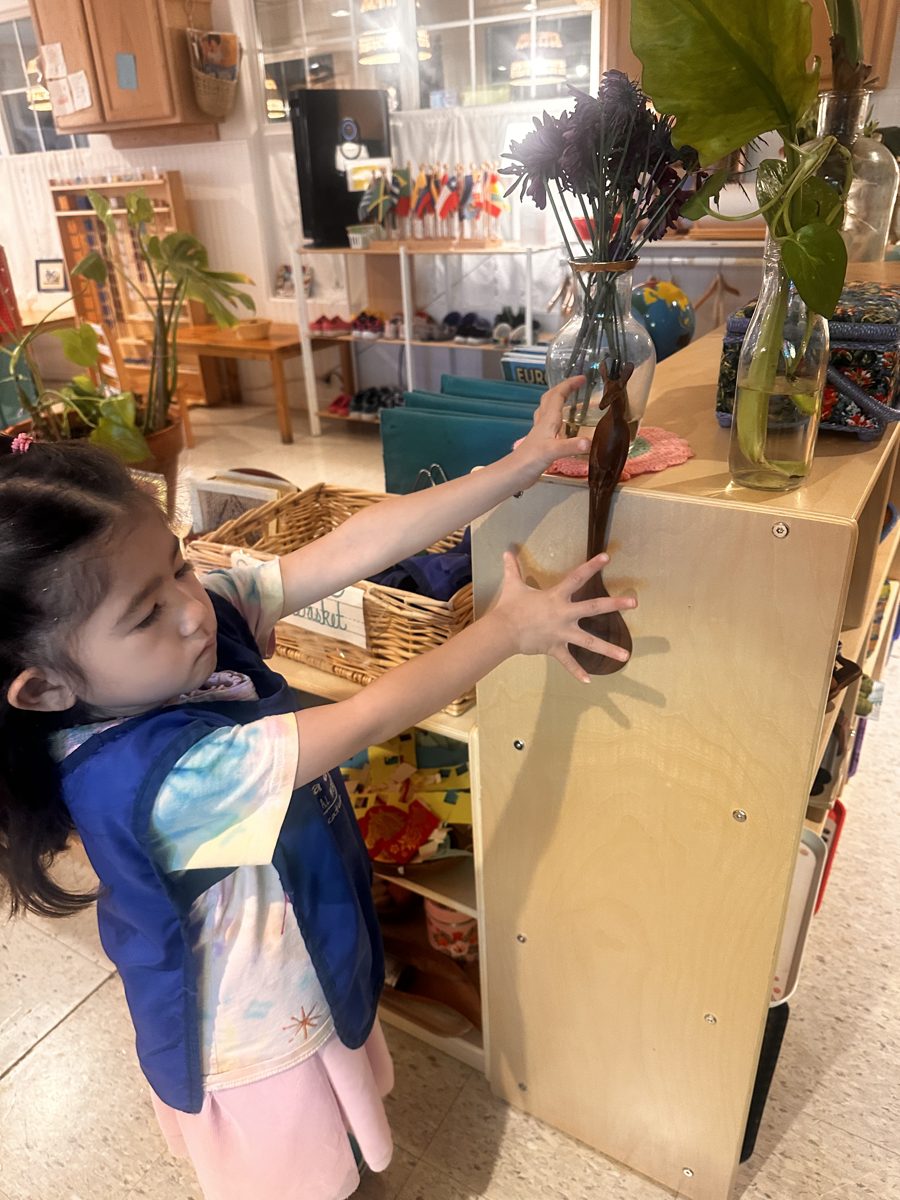
No yard? Start small
One sturdy pot with drainage holes, a small unbreakable cup for pouring and an old washcloth are enough. In an apartment, bring a plant from a sunny window to a low table for care, then return it to the light. A tray can be the garden shelf. On a balcony, keep pots, stools and anything climbable away from the railing.
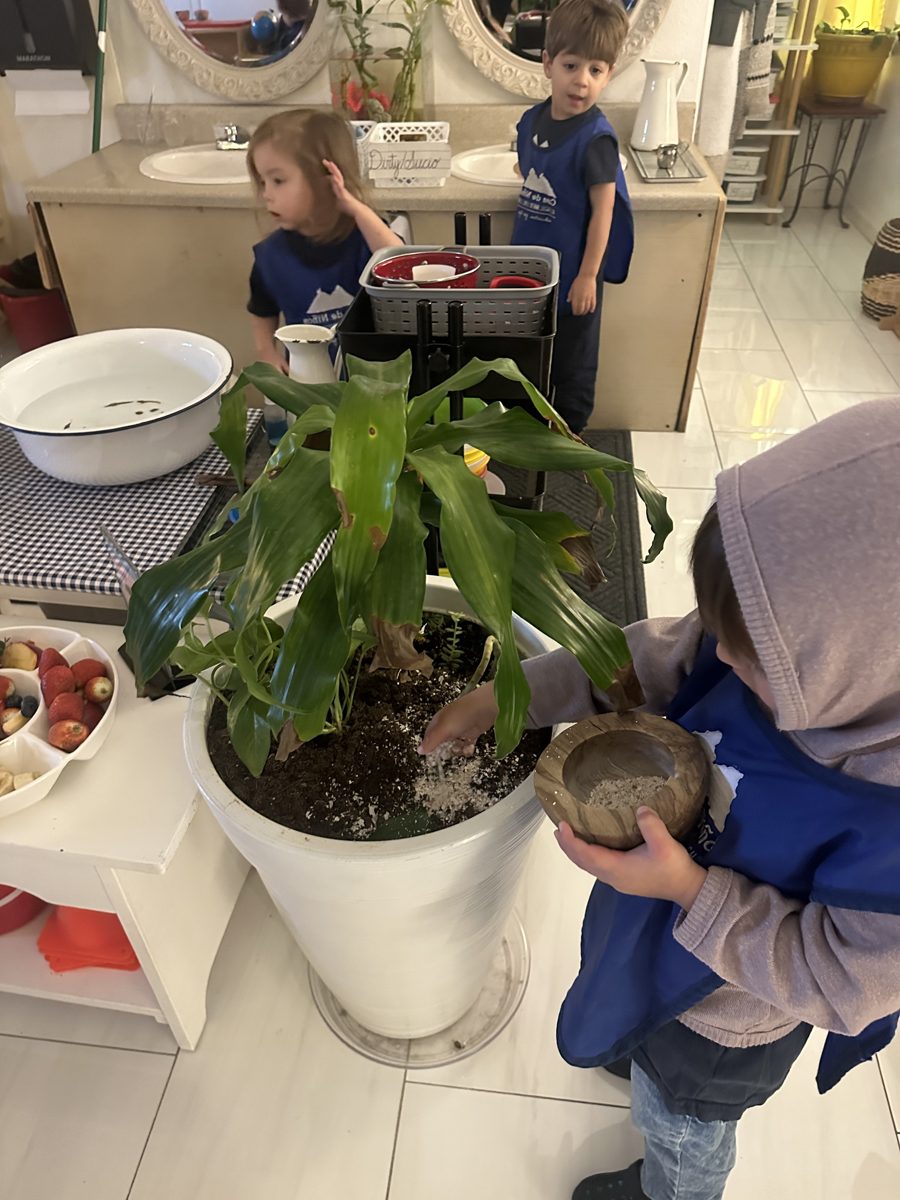
Show the work and give your child a turn
Invite your child to watch. Pick up the watering can, bring the spout close to the soil, pour slowly and set it upright again. Use just a few words, like “Water goes here” or “Vamos a regar.” Show where the can belongs, then give your child a turn.
Step back from directing the work, not from watching over it. If your child is concentrating, let the moment be quiet. If a little water misses the pot, give them time to notice and reach for the cloth. Offer just enough help to keep them going, and step in right away if something becomes unsafe.
Check before you begin
Safety
- Choose plants you know, and check the area for mushrooms or unknown plants first.
- Put sharp or powered tools and garden chemicals out of reach. Adults handle the compost pile.
- Keep small seeds, bulbs, garlic cloves and pebbles away from babies and any child who still puts things in their mouth. For preschoolers, an adult hands out the seeds.
- Bring out only the water the job needs, stay within arm’s reach of babies and toddlers near water, and empty containers right after.
- On very hot Central Texas days, garden early or bring the work inside. Wiping pots or sorting tools is still caring for the garden.
Quick checklist
- ☐ I chose one real job my child can do today.
- ☐ The work area is clear, and each tool has a place to go back to.
- ☐ I checked the plant, the weather and what is within reach.
- ☐ Water is ready in a small amount, and I will stay close.
- ☐ I will show the job slowly, then give my child time to try.
- ☐ We will put the tools back, empty any water and wash hands.
You don’t need a whole garden to begin. When your child knows where the watering can belongs and puts it back after caring for a plant, that little corner of your home is working just like the prepared classroom.
Planting year at a glance
Family favorites, January to December. Many vegetables have two seasons here, one in spring and one in fall.
| Vegetable | Jan | Feb | Mar | Apr | May | Jun | Jul | Aug | Sep | Oct | Nov | Dec |
|---|---|---|---|---|---|---|---|---|---|---|---|---|
| Lettuce · lechuga | ||||||||||||
| Spinach · espinaca | ||||||||||||
| Radishes · rábanos | ||||||||||||
| Carrots · zanahorias | ||||||||||||
| Kale · col rizada | ||||||||||||
| Broccoli transplants · brócoli | ||||||||||||
| English, snap and snow peas · chícharos | ||||||||||||
| Potatoes · papas | ||||||||||||
| Onion transplants · cebolla | ||||||||||||
| Garlic · ajo | ||||||||||||
| Tomato transplants · jitomate | ||||||||||||
| Pepper transplants · chiles | ||||||||||||
| Snap and lima beans · ejotes y frijoles | ||||||||||||
| Summer squash · calabacita | ||||||||||||
| Cucumbers · pepinos | ||||||||||||
| Okra · okra | ||||||||||||
| Pumpkins · calabaza de Halloween | ||||||||||||
| Watermelon · sandía | ||||||||||||
| Sweet potato slips · camote |
Planting time:most of the monthpart of the month
- Broccoli transplantsJanuary (second half), February, September, October
- CarrotsJanuary (second half), February, March (first half), September, October
- CucumbersMarch, April, August
- English, snap and snow peasJanuary (second half), February (first half), September, October (first half)
- GarlicSeptember (second half), October, November
- KaleJanuary (second half), February, September, October, November
- LettuceJanuary, February, March (first half), September (second half), October, November, December
- OkraApril, May, June, July (second half), August (first half)
- Onion transplantsJanuary, February (first half)
- Pepper transplantsMarch (second half), April, May (first half), July (second half), August (first half)
- PotatoesFebruary, August (second half)
- PumpkinsMarch (second half), April, May, June, July (first half)
- RadishesJanuary, February, March, September, October, November, December
- Snap and lima beansMarch, April, August (second half), September (first half)
- SpinachJanuary, February, September (second half), October, November, December
- Summer squashMarch, April, August, September (first half)
- Sweet potato slipsApril (second half), May, June
- Tomato transplantsMarch, April, July, August (first half)
- WatermelonApril, May
More for families
Sources
- Texas Master Gardeners, Williamson County, and Texas A&M AgriLife Extension, Williamson County Vegetable Planting Guide 2026 (planting times and freeze dates)
https://txmg.org/williamson/files/WilliamsonCountyVegetablePlantingGuide2026.pdf - Texas A&M AgriLife Extension, Travis County, “December Gardening Checklist for Austin and Central Texas”
https://travis-tx.tamu.edu/about-2/horticulture/monthly-gardening-calendar-for-austin-area/december-gardening-checklist-for-austin-and-central-texas - Texas A&M AgriLife Extension, Travis County, November gardening checklist for the Austin area
https://travis-tx.tamu.edu/?p=11097 - Texas A&M AgriLife Extension, Travis County, Monthly Gardening Calendar for the Austin Area (a checklist for every month)
https://travis-tx.tamu.edu/about-2/horticulture/monthly-gardening-calendar-for-austin-area/ - Patty G. Leander, Vegetable Garden Planting Guide, Texas A&M AgriLife Extension, January 2025 (Austin freeze dates)
https://agrilifeextension.tamu.edu/vegetablegardenplantingguide-jan2025-english - U.S. Naval Observatory, Astronomical Applications, Phases of the Moon (dates converted to Central Time)
https://aa.usno.navy.mil/data/MoonPhases - timeanddate.com, “Full Moon Names”
https://www.timeanddate.com/astronomy/moon/full-moon-names.html - Gabe Saldana, “Home composting good for garden, environment,” AgriLife Today, July 7, 2020
https://agrilifetoday.tamu.edu/?p=308899 - Association Montessori Internationale (AMI), “The Guidelines for the Prepared Adult in Supporting the Exercises of Practical Life”
https://montessori-ami.org/node/7199 - Association Montessori Internationale (AMI), “Intervening in a Child’s Work”
https://montessori-ami.org/questions/intervening-childs-work - University of Arizona Cooperative Extension, “Gardening with Children in Early Care and Education Centers and Classrooms”
https://extension.arizona.edu/publication/gardening-children-early-care-and-education-centers-and-classrooms - American Academy of Pediatrics, HealthyChildren.org, “Choking Prevention”
https://www.healthychildren.org/English/health-issues/injuries-emergencies/Pages/Choking-Prevention.aspx - American Academy of Pediatrics, HealthyChildren.org, “Water Safety and Young Children”
https://www.healthychildren.org/English/safety-prevention/at-play/Pages/Water-Safety-And-Young-Children.aspx
Come see the Casa garden
Visit our classrooms and garden and see how children care for their environment every day.
Book a Tuesday tourHelp grow the Casa garden. Time, plants, seeds, soil, compost or garden tools are always appreciated. Let your child's guide or the front office know, or contact us.
Happy planting,
Admin
Casa de Niños Bilingual Montessori School
For more tips, follow @casadeninosbilingualmontessori
← Back to the Casa Blog